The First Fully-Illustrated Pips: The Sola-Busca Deck
by Redazione · 8 October 2026 · 8 min read
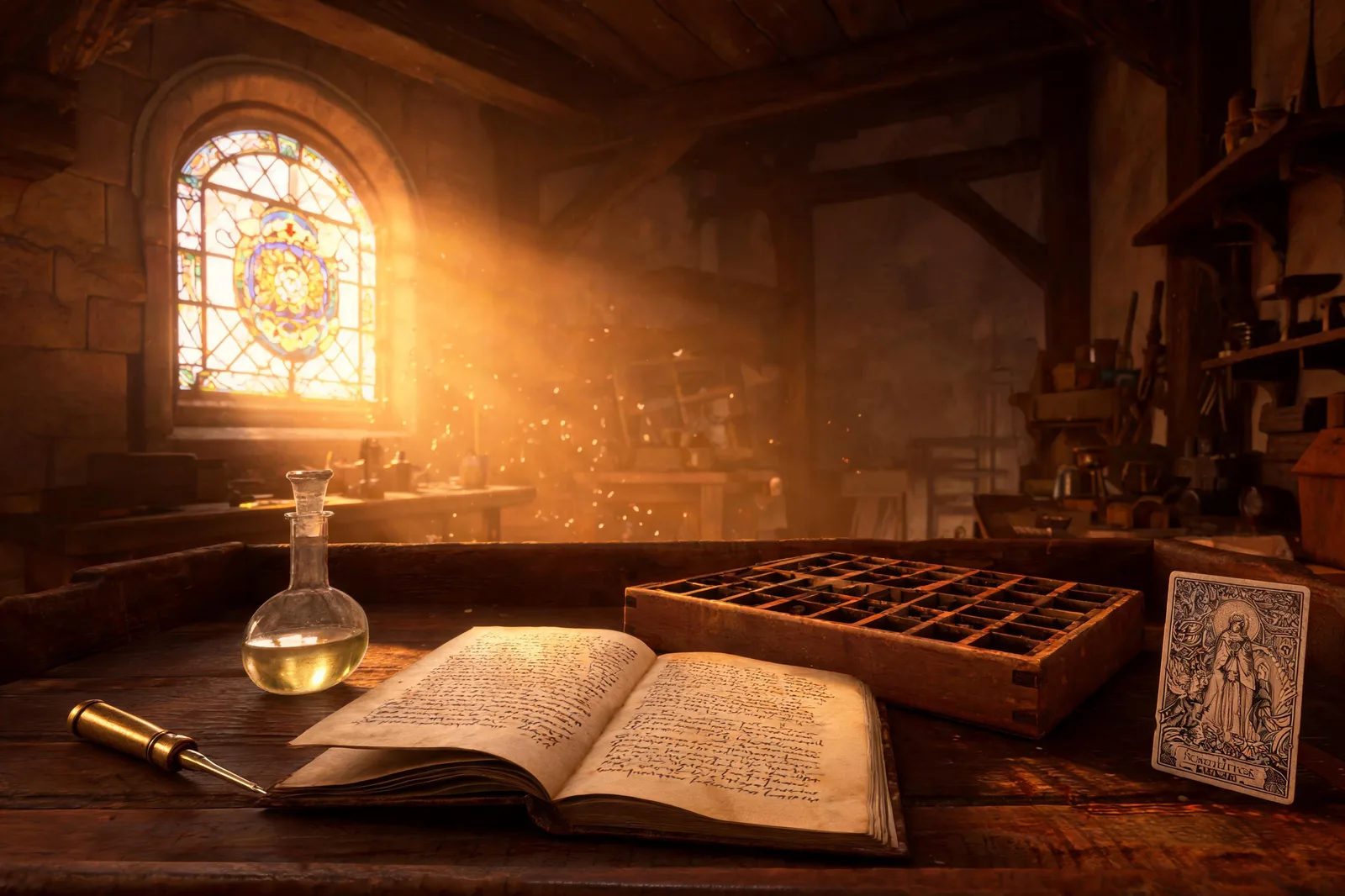
Every modern reader of the Thoth deck assumes that the illustrated minor arcana are an esoteric invention of the twentieth century. That is the story the Golden Dawn and A. E. Waite handed down. But a single deck, painted in Italy in 1491 and then forgotten for four hundred years, already had all fifty-six suit cards drawn as scenes. The Sola Busca tarot is the earliest complete 78-card deck we possess, and it is also the earliest deck in which the plain numerals are fully illustrated. It matters to every deck that followed because it is the bridge between the plain pips of Marseille and the illustrated scenes of the Waite-Smith and Thoth cards.
This is the first part of a series on where the modern minor arcana actually come from. The thesis is simple: the fully illustrated minor arcana descend from the Sola Busca, through the Waite-Smith deck, not from any continuous esoteric tradition. Part one establishes what the deck is and what it is not.
What the deck actually is
The Sola Busca is a set of seventy-eight engraved prints. It holds twenty-one trumps, the Fool, and fifty-six suit cards in four suits. Two things separate it from every deck before it. First, its cards are numbered. The trumps carry Roman numerals and the pips carry small Arabic numerals, an arrangement the Visconti-Sforza decks of the 1450s did not use. Second, and more important for this series, its numeral cards are not rows of repeated suit symbols. They are scenes.
The deck was engraved onto metal by an unknown artist in the late fifteenth century. Arthur Mayger Hind, reading the inscriptions on the cards, proposed in 1938 that it was engraved around 1490 and then hand-painted in 1491. Only one complete hand-painted copy survives. It is in the Pinacoteca di Brera in Milan, bought by the Italian state in 2009 for 800,000 euros. Thirty-five unpainted impressions survive in museums: twenty-three in the Albertina in Vienna, four in the British Museum, and others in Hamburg and Paris. The uncoloured cards are the ones that matter most to a student of the design, because the paint applied in 1491 softened and partly covered the engraver's fine lines (Wikipedia, "Sola Busca tarot").
The name itself is an accident of ownership. It comes from two former owners, Count Sola and the Marchese Busca, whose illuminated copy the Brera acquired. That is all the name means. There is no "sola busca" philosophy hidden in it.
Two more details belong in the record. The Fool, the one trump every reader recognises, is called Matte and is numbered zero, the earliest known case of giving the Fool a number. And the court cards are numbered eleven through fourteen, each one named for a historical or mythic figure. The deck was built to be read as a set of people, not as a set of symbols.
The trumps are a humanist moral cycle
The trump cards break the traditional iconography completely. Where a Marseille deck gives you the Pope, the Empress and the Wheel, the Sola Busca gives you named figures drawn from Roman antiquity and biblical history: Nebuchadnezzar, Gaius Marius, the uncle of Julius Caesar, Bacchus. The figures loosely trace the rise and fall of the Roman Empire, and every one of the twenty-two trumps is a male.
That is the key to reading the deck correctly. The trumps are not a symbolic system in the occult sense. They are a set of moral exemplars, chosen for a humanist audience that would recognise a classical hero and a biblical king. The queens of the court cards, by contrast, are drawn from Boccaccio's De claris mulieribus, a fifteenth-century catalogue of famous women. The deck is a product of Italian humanism. It reaches for Rome, for Greece, for the Bible and for the alchemical literature of the Renaissance. It does not reach for a Kabbalistic tree or a Hermetic chain of being.
The minor arcana are the real innovation
Here is where the Sola Busca matters to your deck. In every deck before it, the minor arcana were pips: the same suit symbol repeated a number of times, arranged in a pattern. The Sola Busca fills each numeral with a small narrative scene. A young man points to a medallion and holds a bird. A knight on horseback wields an enormous sword. The scenes allude to alchemical imagery: the pursuit of the philosopher's stone, the gold of the philosophers, transformation and regeneration framed in the language of the laboratory.
The scholar Sofia Di Vincenzo argued in 1995 that many of these images are tied to Renaissance alchemy. That is defensible for a number of cards. But the deck does not spell out a coherent alchemical programme. There is no consistent sequence, no single narrative running from the Ace to the Ten. What it offers is a scatter of didactic metaphors set inside a broader moral and humanist discourse. It is suggestive, not systematic. That distinction is exactly why later occultists could read so much into it, and why a careful reader should not.
Compare this to a Marseille numeral, where the same club or cup appears a fixed number of times and nothing else is meant. The Sola Busca turned that empty count into a small picture with a moral or alchemical charge. That single move is the seed of everything you now take for granted on a minor card.
The Sola Busca tarot, read as a humanist deck
The Sola Busca is not a grimoire. It is not an esoteric key to a secret doctrine. The most common error is to treat it as a lost occult manual that the Golden Dawn "recovered." That framing is wrong in the direction it points. The deck predates the whole occult revival by three centuries. It belongs to a world before the systematic tarot of Etteilla, before Court de Gébelin's Egyptian myth, before the Kabbalistic attributions of the nineteenth century. A Game Called Trionfi: What the Visconti-Sforza Deck Actually Is The Sola Busca sits on the same humanist soil as the Visconti-Sforza decks, but where those are luxury objects for a ducal court, this one is a printed, numbered, widely reproducible deck with an alchemical and moral bent.
The line to Waite and Smith
The deck vanished from view after the 1500s. In 1907 the Busca-Serbelloni family donated black-and-white photographs of all seventy-eight cards to the British Museum. In 1909, A. E. Waite was shown the deck by a friend, Professor Luigi Speranza, and was struck by one thing above all: the fully illustrated numerals (World of Playing Cards, "The Sola-Busca Tarot"). Until then every deck he knew, Marseille included, had plain pips. He decided his own deck would carry scenes on the minor arcana.
Pamela Colman Smith drew those scenes two years after the photographs reached the museum. Some scholars have pointed to direct echoes: the Three of Swords in the Rider-Waite deck, and the Ten of Wands, which closely resembles the Ten of Swords in the Sola Busca. That is a plausible and honest reading. Smith did not copy the Sola Busca. She worked from Waite's written instructions and her own visual language. But the deck gave her, and Waite before her, a proven precedent: that a numeral card can be a picture instead of a count.
It is worth stating what the precedent did not do. It did not hand Waite a meaning system. The Sola Busca's numerals carry alchemical and humanist overtones, but they carry no Kabbalah, no planetary rulers and no sephirothic placement. When those appeared, they came from the nineteenth-century occultists, not from this deck. The Sola Busca supplied the form. The Golden Dawn supplied the content.
What this changes for a reader of Thoth
When you turn up the Seven of Cups or the King of Wands in a Thoth reading, you are holding a card whose very existence is a modern innovation with a four-hundred-year gap behind it. The illustrated minor arcana are not a revelation handed down from an ancient mystery tradition. They are a design choice, made possible because one Italian deck from 1491 proved that a suit card could tell a scene. The meaning you read into those cards is yours, layered on top of Crowley's, on top of Waite's, on top of a humanist engraver who simply wanted the pips to be worth looking at.
That reframes a small but real question about authority in a reading. When a Thoth minor card feels "deep," that depth is not the residue of a medieval mystery school. It is the accumulated work of three generations of designers and occultists who chose to make a count into a story, and then to load that story with a meaning system the Sola Busca never had. Knowing where the picture ends and the attribution begins lets you read the card as a card, not as a relic. That is the same move we made in Why Waite's Pictorial Key Rewrote Lévi when we watched a meaning system get written over a deck that was not built to carry it.
In the next part of this series we take the Sola Busca's trumps one by one and match each named figure to the card it quietly became, so that you can see the humanist exemplar standing behind the occult symbol you already know.
Questions
Is the Sola Busca the oldest tarot deck?
It is the oldest complete 78-card deck that survives, and the first in which every minor-arcana numeral is illustrated. The Visconti-Sforza decks are older but are hand-painted luxury sets with plain pips.
Did Waite and Smith copy the Sola Busca?
Not directly. Waite saw it around 1909 and took its fully illustrated numerals as a precedent. Smith drew her own scenes from Waite's instructions, though a few cards show clear echoes of Sola-Busca compositions.
Is the Sola Busca an esoteric or alchemical deck?
It carries alchemical and humanist imagery on many numerals, but it spells out no systematic occult programme. It is a moral and humanist deck, not a grimoire.
Where does the Sola Busca deck live today?
The complete hand-painted deck is in the Pinacoteca di Brera in Milan. Unpainted impressions are in the Albertina in Vienna, the British Museum, and collections in Hamburg and Paris.
You might also like
 Symbolism
 Symbolism
 Symbolism
© 2026 TAROTS chat (tarots.chat). All rights reserved. No part of this article may be reproduced, distributed or adapted without the owner's written permission.
The Journal
 Thoth Tarot
 Thoth Tarot
 Kabbalah
 Thoth Tarot
 Thoth Tarot
 Thoth Tarot