Why 22 = 3 + 7 + 12: The Number Structure of the Deck
by Redazione · 8 October 2026 · 8 min read
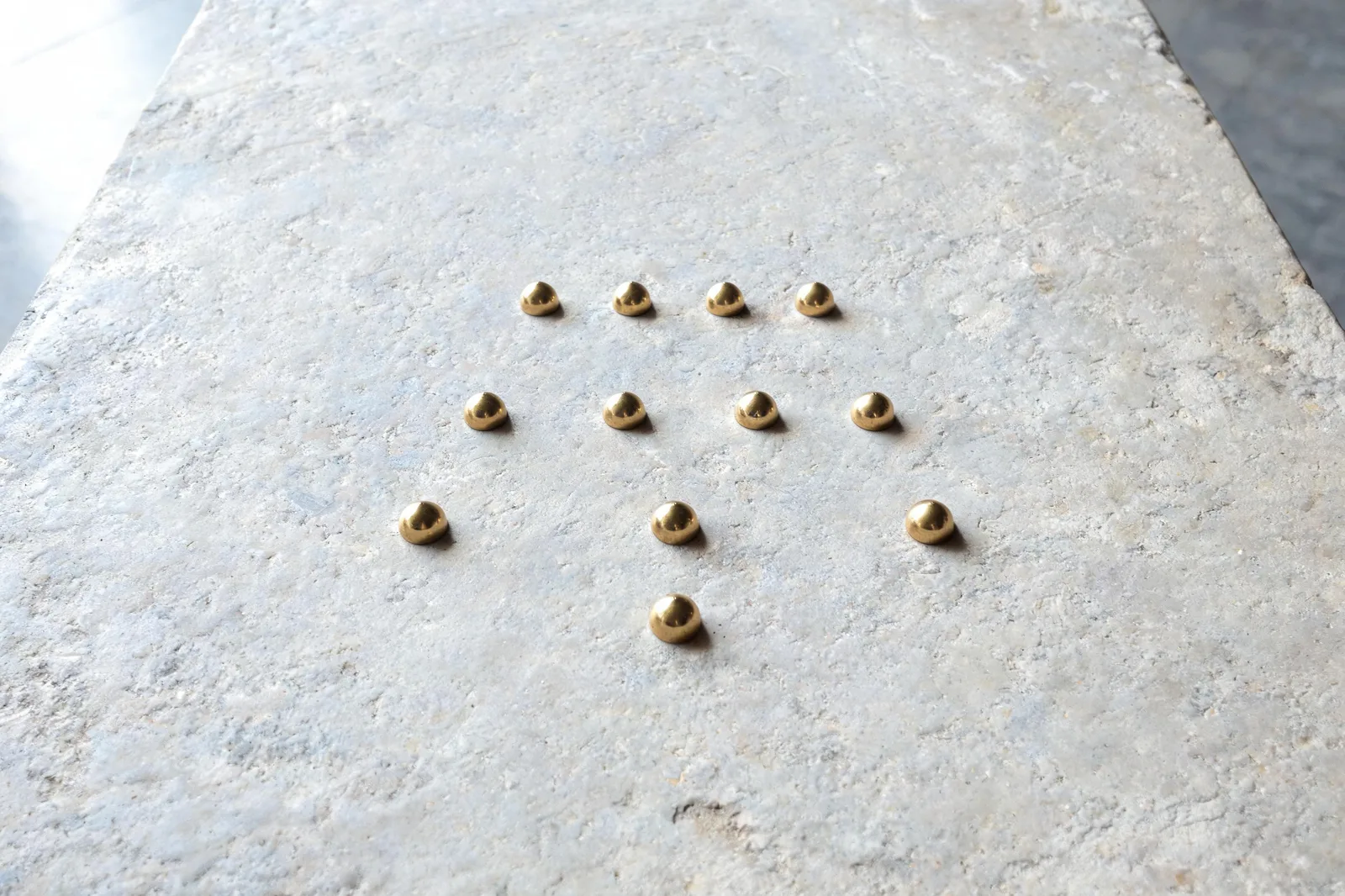
The number the deck is made of
The tarot 22 trumps number question is not "why twenty-two". That is the surface question, and it has a clean answer: twenty-two is the number of the Hebrew letters, and the Golden Dawn wrote the letters onto the trumps. But a reader of the Thoth deck holds something more than that. The deck has a number structure, and the number structure is not the letters. It is the arithmetic the letters sit on.
The number is 22. The deck is 78. And 78 is a triangular number: the sum of 1 through 12. The two numbers are not chosen. They fall out of a shape.
22 as a triangle
A triangular number is the number of points you can lay out in an equilateral triangle. One point. Three. Six. Ten. Fifteen. Twenty-one. Twenty-two is not one of them. Let me be exact, because this is where the deck's arithmetic begins.
Twenty-two is not triangular. Twenty-one is: 1 + 2 + 3 + 4 + 5 + 6 + 7. The deck has twenty-two trumps, not twenty-one. So the trumps are the seventh triangular number plus one. The plus one is the Fool, the zero card, the card that sits outside the triangle. The twenty-one numbered trumps are the triangle; the Fool is the point the triangle is built around and then left out.
That is not a small detail. It is the deck's first structural fact: the trumps are a triangular number plus the unnumbered card.
It is also why the Fool is card zero. Not because the card is missing a number, but because the triangle needs a point that is not inside it. The twenty-one numbered trumps form a closed figure. The Fool is the figure's centre, and a centre is not a member of the ring. The deck's own numbering, from I to XXI, is the ring. The Fool, the unnumbered card, is the point that the ring is drawn around.
78 as a triangle
The full deck is 78. And 78 is triangular: 1 + 2 + 3 + 4 + 5 + 6 + 7 + 8 + 9 + 10 + 11 + 12. The twelfth triangular number. The minor arcana is what makes the triangle close.
The trumps are 22, the triangle of seven plus the Fool. The minor arcana is 56. And 56 is four suits of 14: four rows, each row fourteen. Four is the tetrad. Fourteen is two sevens. So the minor arcana is a grid of four by fourteen, which is four by two by seven. The number seven is the load-bearing number of the lower half of the deck.
The 14 of each suit is not a random length. Ten is the tetractys' number, the unity of the higher order. The court adds four, the tetrad again. So each suit is ten plus four, the tetractys and its own row count. The four suits multiply the tetrad by four, giving 56. And 56 plus the 22 trumps is 78, the large triangle. The deck's two halves are not two separate designs. They are the same figure: a small triangle and a large triangle, joined at the Fool.
The tetractys
The tetractys is the figure that makes all of this legible. It is the triangle of ten points in four rows: one, two, three, four. The Pythagoreans swore by it. The four rows are the four classical elements, and the ten points are the unity of a higher order. The figure is the fourth triangular number.
The deck is built on the same figure, scaled up. The four elements become the four suits. The ten become the ten number cards of each suit, with the court of four above them. The tetractys is the deck's skeleton: four rows, ten points, and the number seven appearing as the count of the planets the Golden Dawn assigned to the suits.
The tarot 22 trumps number, broken into 3, 7 and 12
The decomposition the deck's structure turns on is 22 = 3 + 7 + 12. Three, seven, and twelve. These are the three scales of the deck's number logic.
Three is the smallest triangle in the row, and it is the number of the deck's own structure: the Fool as one, the numbered trumps as a run, the deck as a whole. Seven is the number of the minor arcana's rows: seven of each figure in the suit, the seven classical planets, the seven sephiroth above Daat. Twelve is the number that closes the large triangle: the twelfth triangular number is 78, the whole deck.
The three, the seven and the twelve are not three separate ideas. They are the same figure at three sizes: the small triangle, the middle triangle, the large triangle. The deck is one figure drawn at three scales.
The three sevens
The number seven appears in the deck three times, and the three appearances are not the same seven. That is the point a reader misses.
The first seven is the seven of each suit: the Ace through the Seven, the number cards below the court. The second seven is the seven classical planets, the ones the Golden Dawn assigned to the suits, to the courts, and to the trumps. The third seven is the seven sephiroth above Daat on the tree of life, the sephiroth that the trumps carry.
These are three different sevens, and they are not interchangeable. The seven of a suit is a count within a row. The seven planets are a set of correspondences. The seven sephiroth are a ladder. The deck's number structure is the fact that all three of these sevens are present, and that they are not the same number doing the same job.
For a reader of the Thoth deck, the three sevens are the deck's inner logic. They are the reason the deck feels like it has more going on than the cards show. It does. The three sevens are the structure, and the cards are the surface the structure is poured through.
What it encodes
Does the number structure encode anything? The honest answer is that it encodes the shape, not the content. The deck is a triangular number plus one, sitting on a grid of four by fourteen, sitting on the tetractys. That is a shape. The content, the meanings of the cards, is a separate layer laid on top of the shape.
There is a difference between a shape and a meaning, and the deck has both, in different orders. The shape is old. The tetractys is Pythagorean, and the four-element grid is older still. The meaning is newer. The meanings a reader pulls from a card are a reading tradition, and the reading tradition is a different object from the number structure that the deck is built on.
A reader of the Thoth deck holds both. The shape is the deck's frame, and the meaning is the reading's content. The frame is not the content, and the content is not the frame. But the content is poured into the frame, and the frame is the number structure. That is the relationship the article is about.
For a reader of the Thoth deck, the shape is the frame. Crowley drew on the shape. The Fool sits where the shape leaves a place for it. The court cards sit where the tetractys leaves a row for them. The number structure is not a secret. It is a scaffold.
What this gives the reader
The practical payoff is that the deck is not 78 arbitrary cards. It is 22, which is a triangle plus the Fool, and 78, which is a larger triangle, and the two are the same figure at two sizes. The number structure is the reason the deck feels like it has a shape. It does. The shape is the tetractys, drawn twice, with a grid of four and fourteen in between.
Read the deck as a number first, and the cards sit in their places. The Fool is the plus one. The court cards are the tetractys row. The pips are the ten. The number structure is not a meaning. It is the shape the meanings are poured into.
The deck's number structure is the oldest thing the deck carries. The tetractys is Pythagorean. The four elements are older than Pythagoras. The seven planets are the astronomy of the classical world. The Golden Dawn did not invent the number structure. It wrote the letters on top of it. A reader of the Thoth deck inherits both: the letters, which are a reading tradition, and the number structure, which is a shape. The shape is the deck. The letters are the reading.
For the letters on the trumps, see the companion article on the 22 letters and the tarot. Tarot and Kabbalah: How the 22 Trumps Became the Hebrew Letters For the Fool as the zero position, see the article on tzimtzum. Tzimtzum and the Fool: A Card for the Withdrawal of Light
The sources for the tetractys are the Wikipedia entry on the tetractys and the Wikipedia entry on triangular numbers. The deck's own number logic is in Michael Dummett, The Game of Tarot (1980).
Questions
Why does the tarot have 22 trumps?
Twenty-one is a triangular number (1+2+...+7). The deck has twenty-two: the seventh triangular number plus the Fool, the unnumbered card that sits outside the figure as its centre.
Is 78 a meaningful number?
Yes. 78 is the twelfth triangular number (1+2+...+12). The full deck is one large triangle; the trumps are a smaller triangle plus the Fool. The two halves are the same figure at two scales.
What is the tetractys?
The tetractys is the Pythagorean triangle of ten points in four rows (1, 2, 3, 4). It is the deck's skeleton: the four rows become the four suits, the ten becomes the number cards, the court of four sits above them.
Does the number structure give the cards their meanings?
No. The number structure is the shape the deck is built on; the meanings are a separate reading tradition layered on top. The shape is old, Pythagorean and older; the meanings are newer.
You might also like
 Symbolism
 Thoth Tarot
© 2026 TAROTS chat (tarots.chat). All rights reserved. No part of this article may be reproduced, distributed or adapted without the owner's written permission.
The Journal
From the Journal
Chosen for this page
 Symbolism
Western Esotericism as a Discipline: Faivre, Hanegraaff and the Aries Journal
8 min read
More in Symbolism Thoth Tarot
Picatrix and the Decans: Where the Minor Arcana's Astrology Comes From
9 min read
More in Thoth Tarot Kabbalah
 Kabbalah
 Kabbalah
 Thoth Tarot
 Thoth Tarot