Mercy and Severity: Reading the Two Pillars in a Spread
by Redazione · 9 October 2026 · 4 min read
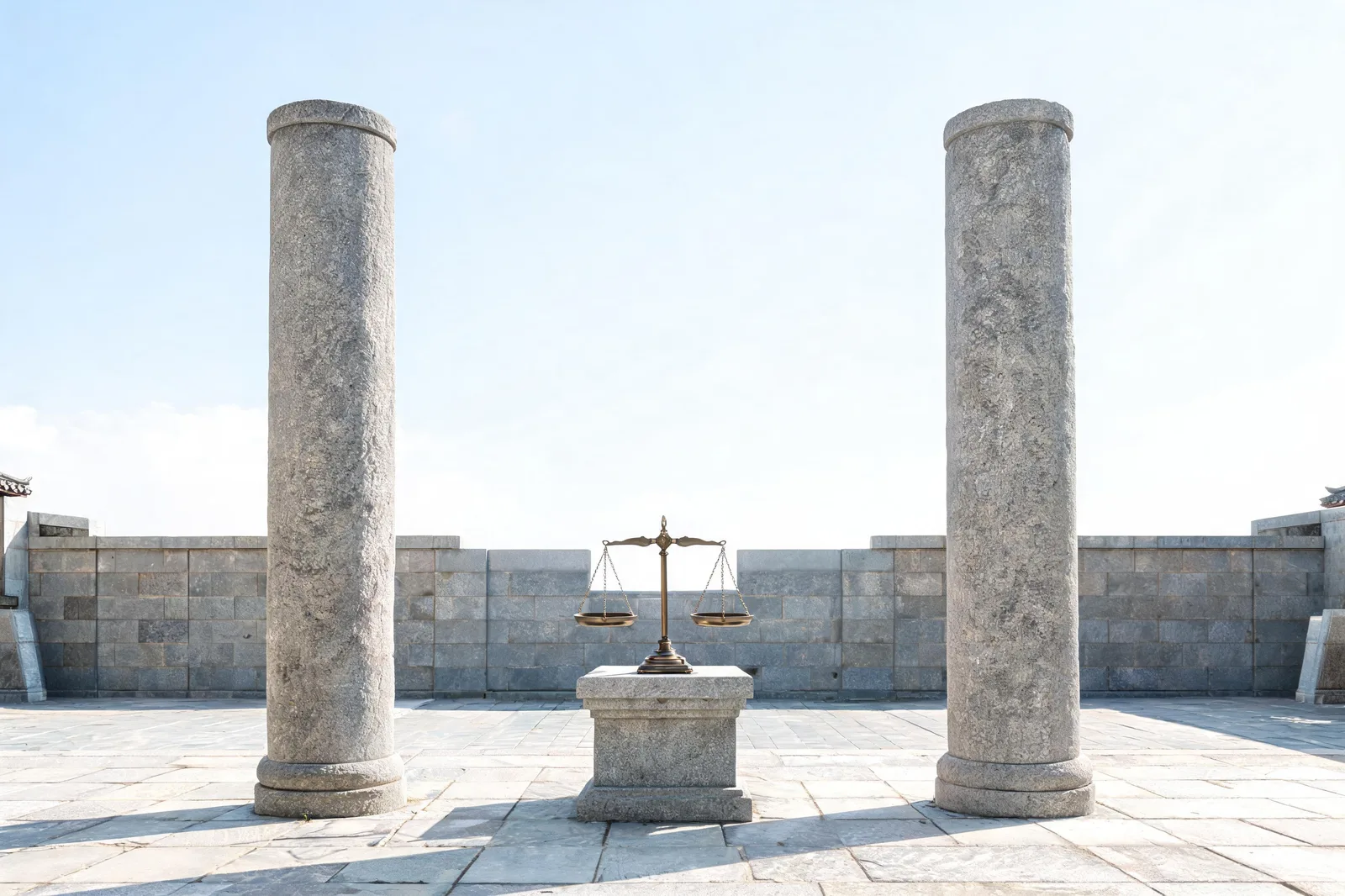
A mercy and severity tarot spread reads the two outer pillars of the Tree of Life into the cards on the table, and this closing part of the series brings the whole structure down to practice. The Tree is traditionally drawn in three columns: a right-hand Pillar of Mercy, a left-hand Pillar of Severity, and a Middle Pillar of Balance running between them. A reader who has followed this series from The Zohar and the Imagery of the Major Arcana through Ein Sof, the Four Worlds and the breaking of the vessels now has the full structure needed to read a spread's left and right sides as more than visual arrangement.
The three pillars, briefly
Chokmah, Chesed and Netzach sit on the right-hand Pillar of Mercy: expansive, giving, outward-reaching forces. Binah, Geburah and Hod sit on the left-hand Pillar of Severity: restrictive, judging, boundary-setting forces. Kether, Tiphareth, Yesod and Malkuth run down the Middle Pillar, holding and balancing the two outer columns rather than leaning toward either. A clear diagram and explanation of this three-column structure is available in the broader Wikipedia article on the Tree of Life in Kabbalah, useful as a visual reference while reading this section.
Why the Tree needs two opposing columns
Neither pillar is good or bad on its own; each corrects the other's excess. Unchecked mercy becomes shapeless indulgence, giving without boundary until nothing holds its form. Unchecked severity becomes cruelty, restriction without compassion until nothing can grow. Kabbalistic teaching insists the two must balance through the Middle Pillar, never that one should defeat the other outright. Adjustment, the trump most directly concerned with weighing and balance, carries this same lesson in a single image: a figure holding scales level, neither pan allowed to fall.
Reading pillar logic into card pairs
A reader can carry this structure into an ordinary spread by noticing which cards lean expansive and which lean restrictive, independent of their usual individual meanings. A card suggesting growth, generosity or opening, paired in the same reading with a card suggesting limit, caution or closing, is not necessarily a contradiction to be resolved in favour of one side. It can be read as the spread itself describing a needed balance, mercy and severity sitting together because the situation actually requires both at once. This reframes what many readers treat as "conflicting cards" into a more specific, more useful observation about where a balance is currently missing.
A practical mercy and severity tarot spread technique
In a layout with clearly distinguished left and right positions, such as the Celtic Cross, a reader can deliberately ask which position in the given spread leans toward Mercy's qualities and which leans toward Severity's, then read the card landing there with that pillar in mind. A card of restriction falling in a position already associated with challenge or obstacle reads differently, and perhaps more sharply, than the same card falling in a position associated with outcome or future direction. This technique works as an overlay on any spread with directional positions, not only ones built explicitly around the Tree.
Closing the series
This series began with Ein Sof, a source before any attribute, and has moved steadily toward structure: worlds, a name, numbers, a primordial body, a presence that dwells, a breaking, a repair, a text that teaches through image. The two pillars, and the balance a reader learns to hold between them, are a fitting place to close, because they describe what every stage of this series has actually been doing: taking something vast and holding it, carefully, in a form small enough for a single card, a single spread, a single honest conversation at the table.
FAQ
Which pillar is "better," Mercy or Severity? Neither. Kabbalistic teaching treats both as necessary and potentially harmful in excess; balance between them, held by the Middle Pillar, is the goal, not the dominance of one side.
Does every spread need to be read through the pillars? No. This is one optional lens among several a reader can apply, most useful in spreads with clear left-right or directional positions, not a required step for every reading.
Which sephirot belong to each pillar? Chokmah, Chesed and Netzach form the right-hand Pillar of Mercy; Binah, Geburah and Hod form the left-hand Pillar of Severity; Kether, Tiphareth, Yesod and Malkuth run down the Middle Pillar between them.
How does Adjustment relate to the pillars? Adjustment shows a figure holding scales level, a single-card image of exactly what the Middle Pillar is said to do across the whole Tree: holding two opposing forces in working balance.
Questions
Which pillar is "better," Mercy or Severity?
Neither. Kabbalistic teaching treats both as necessary and potentially harmful in excess; balance between them, held by the Middle Pillar, is the goal, not the dominance of one side.
Does every spread need to be read through the pillars?
No. This is one optional lens among several a reader can apply, most useful in spreads with clear left-right or directional positions, not a required step for every reading.
Which sephirot belong to each pillar?
Chokmah, Chesed and Netzach form the right-hand Pillar of Mercy; Binah, Geburah and Hod form the left-hand Pillar of Severity; Kether, Tiphareth, Yesod and Malkuth run down the Middle Pillar between them.
How does Adjustment relate to the pillars?
Adjustment shows a figure holding scales level, a single-card image of exactly what the Middle Pillar is said to do across the whole Tree: holding two opposing forces in working balance.
This article talks about
You might also like
 Kabbalah
 Kabbalah
 Kabbalah
© 2026 TAROTS chat (tarots.chat). All rights reserved. No part of this article may be reproduced, distributed or adapted without the owner's written permission.
The Journal
 Kabbalah
 Kabbalah
 Learn Tarot
 Symbolism
 Thoth Tarot
 Spirituality
 Symbolism
 Symbolism