The Death Tarot Card Meaning in the Thoth Deck: A Complete Guide
by Redazione · 28 September 2026 · 7 min read
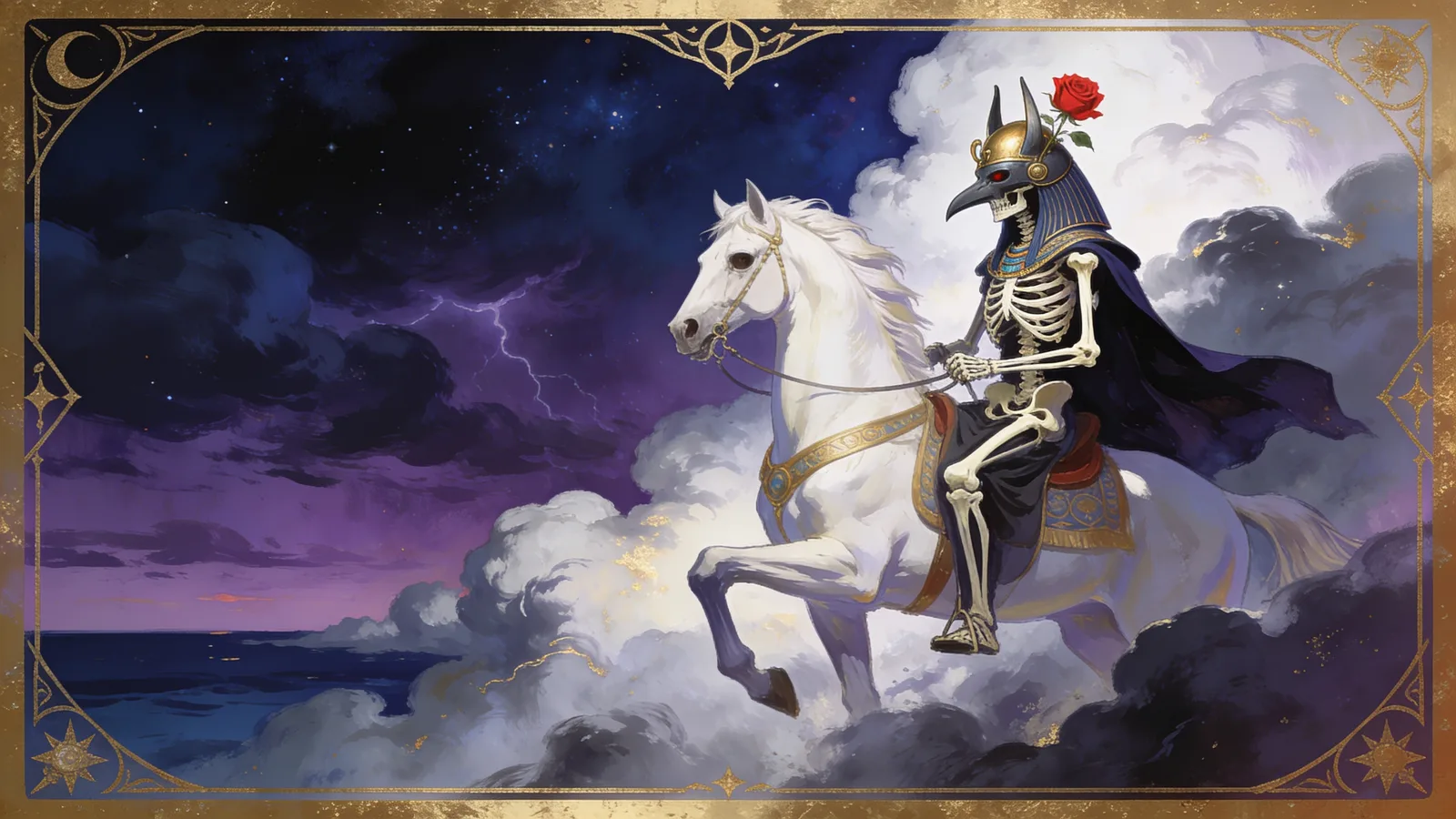
The Death Tarot Card Meaning Thoth Deck Readers Look For
When readers search for the death tarot card meaning thoth deck, they find one consistent answer: this is not about physical death at all. It is the card of transformation — endings that make room for new beginnings, the inevitable cycle of release and renewal. In the Thoth system, this card carries the Hebrew letter Mem and sits on the path between Binah and Tiphareth on the Tree of Life. Where Rider-Waite shows a grim reaper scythe-wielding figure, Thoth presents something far more nuanced: a skeletal figure riding a white horse through storm clouds, with a red rose blooming from its helmet. The message is clear — even in destruction, life persists and transforms.
The Symbolism Behind Thoth's Death Card
Lady Frieda Harris painted the Death card with extraordinary precision, embedding layers of Qabalatic meaning into every element:
The white horse represents the astral light — the subtle realm where thoughts take form before manifesting in the physical world. Unlike a living steed, this horse moves with purposeful inevitability, carrying its rider through whatever stands in the way. The skeleton is not a corpse but a purified form: all flesh removed to reveal the essential structure beneath.
The red rose emerging from the helmet's visor is perhaps the most important symbol. It signifies that death is never absolute — something always survives and transforms. In alchemical terms, this is the solve et coagula principle: dissolve what no longer serves, then rebuild on a stronger foundation.
The storm clouds surrounding the rider represent emotional turbulence. Transformation rarely feels calm; it usually arrives with wind, rain, and resistance from whatever wants to hold onto the old way of being. Yet beneath the storm lies an unshakeable certainty — this change will happen whether you welcome it or not. Much like The Tower, which brings sudden upheaval, Death works more gradually but no less decisively.
Death in a Thoth Reading: Upright Meaning
When the Death card appears upright in a reading, it signals a major transition is underway. This is not a minor adjustment but a fundamental shift in how things operate. The specific area of life affected depends on the surrounding cards and your question, but the energy is always the same: something must end so that something new can begin.
In career, Death often marks the conclusion of a project, department, or role that has defined you for years. It may feel like loss initially — especially if you have invested deeply in that work — but the card promises that what follows will be better aligned with who you are becoming rather than who you were.
In relationships, Death can indicate the end of a phase within a partnership. The couple may still be together, but their dynamic shifts dramatically: old patterns dissolve, and they must renegotiate how they relate to each other. Sometimes it signals a clean break when two people have grown into different directions.
For personal growth, Death is one of the most powerful cards you can pull. It asks what identity, belief, or habit needs to die so your next version can emerge. The skeleton riding through storm clouds says: stop resisting. The transformation is already happening whether you are ready or not.
How Thoth's Death Differs from Rider-Waite
The Thoth tarot vs Rider-Waite comparison reveals why this deck feels different to experienced readers. In the Rider-Waite-Smith deck, Death appears as a skeletal figure on a black horse, scythe raised, with people prostrate before it — kings, bishops, children all bowing equally. The imagery is dramatic and unmistakable: death comes for everyone.
Thoth's version is quieter but no less powerful. There is no scythe because the transformation does not cut; it dissolves. The white horse replaces the black one to emphasize that this change moves through the astral plane first — your thoughts, emotions, and beliefs shift before physical circumstances follow. The red rose adds a note of hope absent from Rider-Waite's more austere composition.
Crowley deliberately chose these differences because he wanted the Thoth deck to function as a tool for active psychological work rather than passive fortune-telling. Death in Thoth does not just tell you something will end; it shows you how the ending works and invites you to participate consciously in the process. (For Crowley's own notes on this card, see the Book of Thoth analysis at crowley-thoth.com.)
Death Reversed in Thoth: The Ill-Dignified Position
Unlike Rider-Waite, the Thoth deck has no reversals by design — cards are always read upright regardless of orientation during the shuffle. However, readers who want a "reversed" interpretation use what Crowley called the ill-dignified reading. For Death, this means transformation that is resisted, delayed, or incomplete.
When you pull Death and feel stuck in transition, the card asks: what are you holding onto? The skeleton does not stop for hesitation; it rides through everything. Ill-dignified Death suggests you have built a wall around the change and are trying to protect something that needs to dissolve. The storm clouds are still there — you just chose to stand in front of them rather than move with them.
Using the Death Card in Seasonal Readings
The Death card carries special resonance during seasonal transitions, particularly Scorpio season (October 23 – November 22), when the sun passes through Scorpio's traditional rulership. Scorpio and Death share the same Hebrew letter (Mem) and the same elemental association with water — specifically the deep, transformative waters where old forms break down into their essential components.
A Scorpio season tarot reading featuring Death asks you to examine what has outlived its purpose in your life. What relationships have become routines? Which ambitions no longer excite you? The card invites honest inventory before winter sets in and the energy turns inward.
You can also use a Three cards spread focused on release, transformation, and renewal — one card for what dies, one for what emerges from that change, and one for how to participate consciously rather than resist. This approach works beautifully at any equinox or solstice but is especially potent during Scorpio season when Death's energy is amplified by the astrological climate.
Frequently Asked Questions
Is the Death card always bad in a tarot reading?
No. The Death card primarily signifies transformation and transition, not literal death. In most readings, it indicates that an ending is necessary for growth — which can feel uncomfortable but ultimately leads to positive change. It appears when something has completed its cycle and needs to be released.
What Hebrew letter does the Death card carry in Thoth?
The Death card carries the Hebrew letter Mem (מ), associated with water and the astral plane. On the Tree of Life, it connects Binah (Understanding) to Tiphareth (Beauty/Balance). This placement means transformation flows from deep comprehension through balanced expression into conscious awareness.
How often does the Death card appear in readings?
The Death card appears roughly once every 78 cards when drawing randomly — about 1.3% of individual card pulls. However, it shows up more frequently during periods of significant life change: career transitions, relationship shifts, or seasonal reading dates like Scorpio season and the autumn equinox.
Can the Death card mean literal death?
Yes, but only in specific contexts. If surrounded by cards like The Tower, Nine of Swords, or Ten of Swords, and if you are asking about a particular person's health, Death can indicate physical passing. In most general readings, however, it means transformation rather than mortality.
Should I use Thoth or Rider-Waite for learning the Death card meaning?
Both decks teach valuable lessons. The Thoth deck offers deeper Qabalatic and astrological correspondences that enrich understanding of how transformation works at a structural level. Rider-Waite provides more accessible, universally recognizable imagery ideal for beginners. Many experienced readers study both to build a complete picture.
Questions
Is the Death card always bad in a tarot reading?
No. The Death card primarily signifies transformation and transition, not literal death. In most readings, it indicates that an ending is necessary for growth — which can feel uncomfortable but ultimately leads to positive change.
What Hebrew letter does the Death card carry in Thoth?
The Death card carries the Hebrew letter Mem (מ), associated with water and the astral plane. On the Tree of Life, it connects Binah to Tiphareth, meaning transformation flows from deep comprehension through balanced expression.
How often does the Death card appear in readings?
The Death card appears roughly once every 78 cards when drawing randomly — about 1.3% of individual card pulls. It shows up more frequently during periods of significant life change or seasonal reading dates like Scorpio season.
Can the Death card mean literal death?
Yes, but only in specific contexts. If surrounded by cards like The Tower, Nine of Swords, or Ten of Swords, and if you are asking about a particular person's health, Death can indicate physical passing. In most general readings, however, it means transformation.
Should I use Thoth or Rider-Waite for learning the Death card meaning?
Both decks teach valuable lessons. The Thoth deck offers deeper Qabalatic and astrological correspondences that enrich understanding of how transformation works at a structural level.
This article talks about
You might also like
© 2026 TAROTS chat (tarots.chat). All rights reserved. No part of this article may be reproduced, distributed or adapted without the owner's written permission.
The Journal
From the Journal
 Thoth Tarot
The Sun Tarot Card Meaning in the Thoth Deck
7 min read
 Thoth Tarot
The Hanged Man Tarot Card Meaning in the Thoth Deck
7 min read
 Thoth Tarot
The Tower Tarot Card Meaning in the Thoth Deck
6 min read
 Thoth Tarot
 Learn Tarot
 Tarot Journal
 Spirituality
 Symbolism
 Love
Love