Thoth Tarot vs Rider-Waite: What's the Difference
Two decks built for two different jobs: one to be read at a glance, the other to be studied for years.
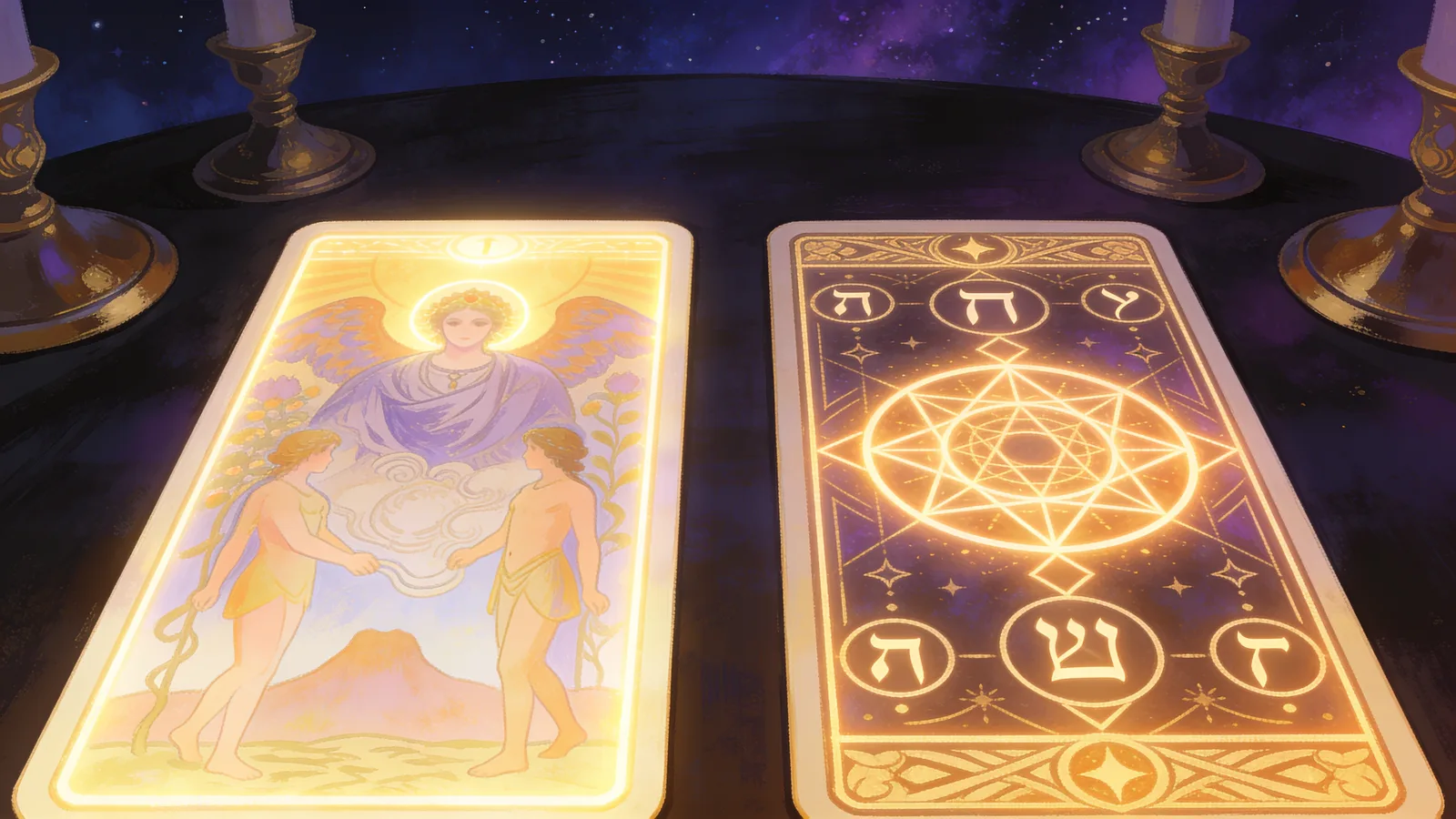
If you have only ever seen the Rider-Waite-Smith deck, the Thoth tarot can feel like a different language. The figures are less literal, the colors are sharper, and every card carries a small cluster of correspondences — a Hebrew letter, a planet or sign, a path on the Tree of Life — that the Rider-Waite deck keeps mostly out of sight. Understanding the Thoth tarot vs Rider-Waite question is really a question about two different projects: one built to be read at a glance, the other built to be studied.
Two decks, two intentions
The Rider-Waite-Smith deck (1909) was designed by A.E. Waite and painted by Pamela Colman Smith for the Golden Dawn's more public, teachable face of tarot. Every minor arcana card shows a small scene — Two of Cups — Love is two figures exchanging a toast, Ten of Swords — Ruin is a body pierced by ten blades under a dark sky — so a beginner can read the picture before learning any theory. The Rider-Waite-Smith deck's history is well documented, including Pamela Colman Smith's own contribution, which went uncredited on the box for decades.
The Thoth tarot, painted by Lady Frieda Harris between 1938 and 1943 to Aleister Crowley's specifications, does the opposite. It assumes the reader already wants the theory: Qabalah, astrology, alchemy and Egyptian myth are folded directly into the composition. A minor arcana card here is closer to a diagram of a force — Swords as Air, Disks as Earth — than a story.
What actually changes on the cards
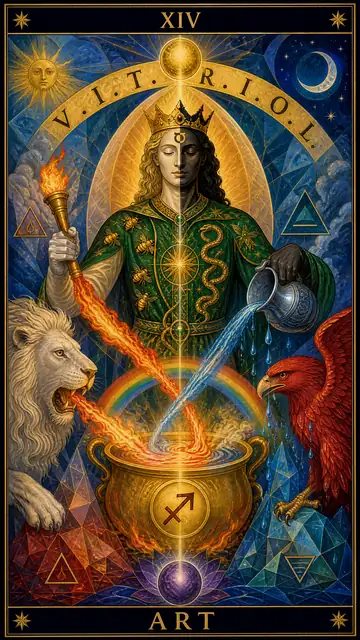
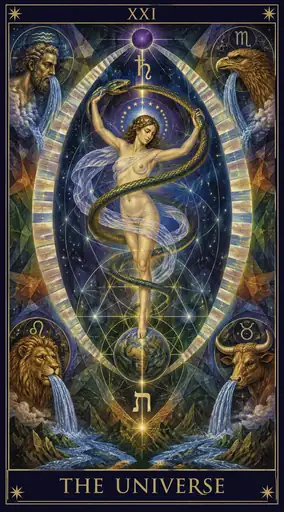
- Titles. Several trumps are renamed to match Crowley's system: Strength becomes Lust, Justice becomes Adjustment, Temperance becomes Art, Judgement becomes The Aeon, and The World becomes The Universe. The renaming is not decoration — each new name points at the correspondence the card is meant to teach.
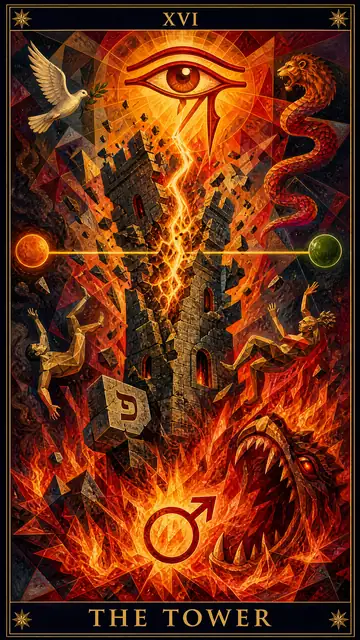
- Astrology on every card. Rider-Waite cards can carry astrological attributions as background knowledge; Thoth cards are built around them. The Tower is explicitly the path of Peh and the letter connected to Mars, not just "a tower struck by lightning."
- No fixed reversed meanings. The Rider-Waite tradition often teaches a reversed meaning for every card. Thoth practice reads a card "ill-dignified" from its neighbors and position instead of flipping it upside down — the picture never changes, only how the surrounding cards color it.
- Court cards renamed. Page, Knight, Queen and King become Princess, Prince, Queen and Knight, each mapped to an element and a stage of the Tree of Life rather than a simple age or rank.
Thoth tarot vs Rider-Waite: which one should you read with?
Neither deck is "more accurate" — they are two teaching tools built for different audiences. If you want to start reading in an afternoon from the pictures alone, Rider-Waite-Smith is the faster on-ramp. If you are already curious about Golden Dawn correspondences, Hermetic Qabalah or astrology, and you want a system where the symbolism keeps teaching you something new after the hundredth reading, the Thoth deck rewards the slower climb. A Three cards with the Thoth deck is a good first test: read Past / Present / Future and notice how quickly you start asking what element or planet each card belongs to.
Reading Thoth without years of study first
You do not need to memorize the Tree of Life before your first Thoth reading. Start with the plain keyword each card carries — Strife, Victory, Disappointment — and let the correspondences arrive as footnotes rather than prerequisites. An AI-guided reading that explains each card in its position, with the Hebrew letter and astrology named alongside the plain meaning, is one practical way to learn the system while it is actually doing something for you, instead of reading a glossary cover to cover first. Over a few readings the correspondences stop feeling like homework and start feeling like a second layer of the same story the picture is already telling.
FAQ
Is the Thoth tarot harder to learn than Rider-Waite? It has a steeper start because the pictures are symbolic rather than literal, but the correspondences are consistent once learned — each suit and number always maps to the same forces.
Can I mix Thoth and Rider-Waite meanings in one reading? It is better not to. The two decks use different attributions for several cards (Strength/Lust, Justice/ Adjustment), so blending their meanings muddies both systems.
Does the Thoth deck have reversed cards? Not in the way Rider-Waite decks are usually taught. Thoth readings use "ill dignity" — how a card is affected by its neighbors — instead of a fixed upside-down meaning.
Who painted the Thoth tarot? Lady Frieda Harris painted the seventy-eight cards between 1938 and 1943, working from Aleister Crowley's specifications; the accompanying Book of Thoth was published in 1944.
Why do some Thoth trumps have different names? Crowley renamed several trumps — Lust for Strength, Adjustment for Justice, Art for Temperance, The Aeon for Judgement — to point directly at the Qabalistic and astrological attribution each card teaches.
Frequently asked questions
Is the Thoth tarot harder to learn than Rider-Waite?
It has a steeper start because the pictures are symbolic rather than literal, but the correspondences are consistent once learned.
Can I mix Thoth and Rider-Waite meanings in one reading?
It is better not to, since the two decks use different attributions for several cards, such as Strength/Lust and Justice/Adjustment.
Does the Thoth deck have reversed cards?
Not in the usual sense. Thoth readings use ill dignity, how a card is affected by its neighbors, instead of a fixed upside-down meaning.
Who painted the Thoth tarot?
Lady Frieda Harris painted the seventy-eight cards between 1938 and 1943 to Aleister Crowley's specifications.
Why do some Thoth trumps have different names?
Crowley renamed several trumps, such as Lust for Strength and Adjustment for Justice, to point at the correspondence each card teaches.
This article talks about
 Two of Cups — Love
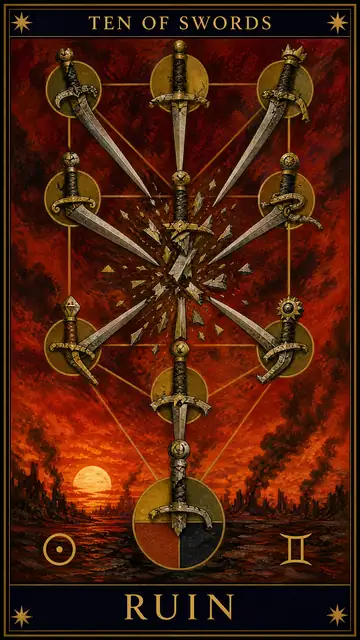 Ten of Swords — Ruin
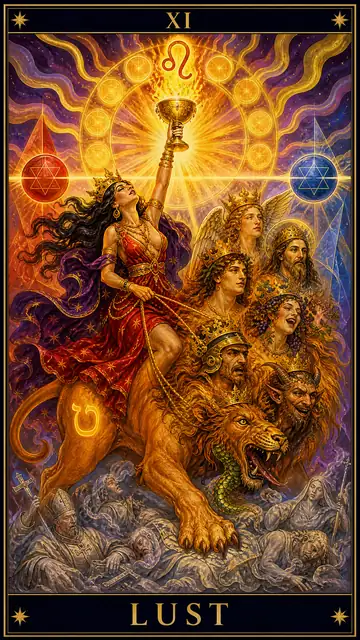 Lust
Lust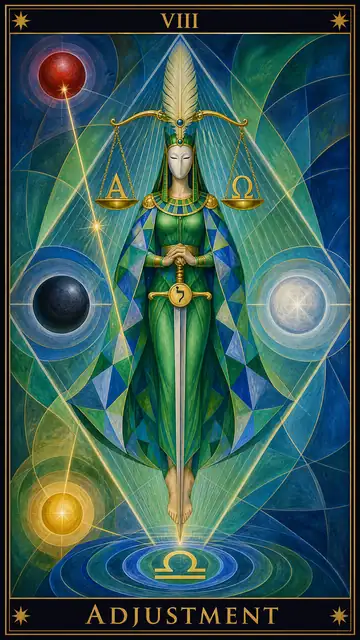 Adjustment
 Art
Art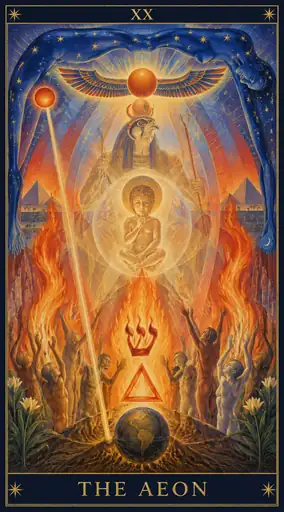 The Aeon
 The Universe
 The Tower
Share this article
You might also like
Aleister Crowley's Book of Thoth Explained
Why the book (1944) and the deck (published 1969) were one project finished a quarter-century apart.
How to Read Tarot Cards: A Beginner's Guide
Suits, positions and one simple three-card spread to get you reading with real instinct, not memorized definitions.
Golden Dawn Tarot Correspondences Explained
How Hebrew letters, astrology and the Tree of Life turn every Thoth tarot card into four systems read as one.