The Voynich Manuscript and the Tarot Question
by Redazione · 7 October 2026 · 9 min read
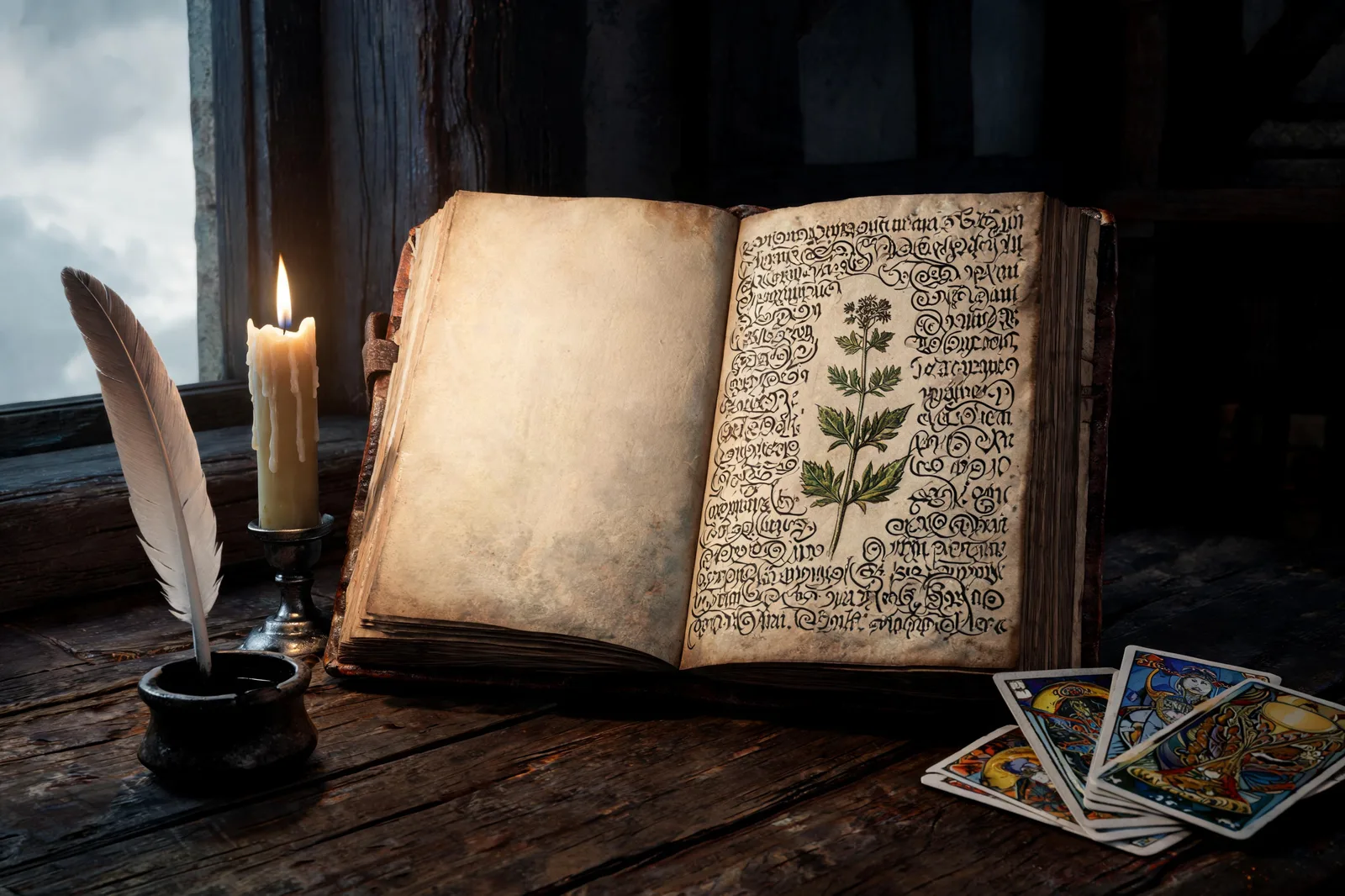
The Voynich manuscript has resisted every attempt to read it for over a century. Carbon-dated to between 1404 and 1438, the codex sits in the Beinecke Library at Yale as a wall of looping, unknown script surrounded by botanical and astronomical drawings that nobody has been able to place in any known language. Around it, a folklore has grown. The manuscript is sometimes cited, without any evidence, as proof that a deck of cards "comes from" an older esoteric source, that the 22 trumps are a fragment of some hidden book that was later copied into playing cards. The voynich manuscript tarot connection is one of the most persistent myths in the field, and it is worth taking apart carefully, because the way the claim is made tells you something about how tarot history is still written, even now.
This article does two things. First it lays out what the manuscript actually is, what we know for certain, and what remains genuinely open. Second it follows the thread of the tarot claim to its source, and shows why the connection, as it is usually stated, does not hold. The question it answers is a simple one: what does an undeciphered fifteenth-century book teach us about the claim that a deck of cards "comes from" some older text?
What we actually know about the Voynich manuscript
The vellum has been carbon-dated to the early fifteenth century, 1404 to 1438. That is a fact, and it is the anchor everything else rests on. The manuscript was composed, by stylistic analysis, most likely in Italy during the early Italian Renaissance. It is roughly 240 pages, with some missing, written in an unknown script that linguists have called "Voynichese" (Wikipedia, "Voynich manuscript"). The text is divided into sections: a botanical section with plants that do not correspond to any known species, an astronomical section with circular charts and zodiac figures, a section of nude figures in bathing pools, a pharmaceutical section with jars, and what appears to be a set of recipes.
The first confirmed owner was Georg Baresch, a Prague alchemist in the late seventeenth century. The manuscript passed through the hands of Athanasius Kircher, who sent two copies to Rome, and later to Wilfrid Voynich, the Polish book dealer who purchased it in 1912 and gave it his name. It has been at Yale since 1969, and has been fully digitized since 2020.
What we do not know: the author, the purpose, the language, and the meaning of the text. Hypotheses range from a constructed language to a substitution cipher to a hoax to a work of fiction. None of these has been settled. The manuscript is a real object with a real date and a real provenance, but its text remains unread.
Where the voynich manuscript tarot claim actually comes from
The idea that the Voynich manuscript contains tarot imagery, or that the trumps derive from it, does not appear in any scholarly source on the manuscript. It appears, instead, in the same cluster of esoteric histories that built the Egyptian origin myth in the first place. Court de Gébelin, in 1781, claimed that the tarot cards were hieroglyphs derived from ancient Egypt. His claim had no documentary basis, and it was repeated, with increasing confidence, by Etteilla and then by the Golden Dawn, as this series has already traced in Court de Gebelin and the Egyptian Myth of 1781.
The Voynich manuscript entered this lineage at a later point, because it is a real undeciphered book from the right century, and because people who believe the trumps are ancient symbols find in it a convenient object. The manuscript is from the early 1400s. The oldest dated tarot cards, the Visconti-Sforza pack, are from the early 1450s. The manuscript predates the cards by roughly four to five decades. That gap is the entire basis of the claim, and it is not a connection.
Michael Dummett, in The Game of Tarot (1980), is the most careful historian of the pack. His argument is built on documentary evidence, not iconography. He traces the deck through its documented game forms, and he reaches the same conclusion Court de Gébelin's opponents reached in the nineteenth century: there is no documentary record of occult significance attached to the cards before 1781. The voynich manuscript tarot question is, in Dummett's framework, a non-question. The manuscript is not a source for the cards. The cards are not a copy of the manuscript.
This is not a position Dummett took to be clever. He took it after reading the documentary record, and the record is what it is. In his 1981 letter to the New York Review of Books, responding to Frances Yates' review, Dummett states it plainly: he brought forward evidence, "based on a multitude of documentary references, that no occult significance was attached to the cards, nor any use made of them save for playing games, until the intervention of Court de Gébelin in 1781." The manuscript does not change that record. It is not in the record. The cards' documented history is a history of games, and the manuscript's is a history of an unread book, and the two histories do not cross.
The 2025 cipher study and why it does not close the gap
In late 2025, a study by Michael Greshko published in Cryptologia proposed a new model: a historically plausible substitution cipher, which Greshko calls the Naibbe cipher, that could reproduce many of the manuscript's statistical properties simultaneously. The model uses structured substitution tables with controlled randomness introduced through dice and playing cards, objects available in fifteenth-century Europe.
Greshko is explicit about what he is and is not claiming. He does not assert that the Naibbe cipher is how the manuscript was created. He does not assert that the manuscript is a ciphertext. What he demonstrates is that a historically realistic mechanism can produce text that looks like Voynichese, which narrows the space of possible explanations and makes the cipher hypothesis more defensible than it was a year ago.
The tarot connection in this study is methodological, not interpretive. Playing cards are used as a randomization tool in the cipher model because they were historically available. That is a different thing from the manuscript being about tarot, or the cards being derived from it. The study does not close the gap between the two. It does not, and is not designed to, establish any content link between the undeciphered text and the trumps.
The paradox of the undeciphered object
There is a deeper reason the manuscript is such a good fit for the tarot myth, and it has nothing to do with the cards at all. An undeciphered text is a perfect placeholder for meaning. It can be anything, and it is not yet anything, so the person who needs a source for a belief can put that belief inside it without the text ever pushing back. A book that says something you can read will, sooner or later, contradict your reading. A book that says nothing legible will not. The Voynich manuscript is the most useful source in the world for anyone who wants to claim that an older text is the origin of the trumps, precisely because it cannot be checked.
This is why the claim survives every debunking. Every time someone produces a better explanation of the manuscript, the tarot version does not have to be abandoned. It simply moves into the gap that remains. The manuscript is still not fully explained, so the gap is still there, so the claim still fits. The voynich manuscript tarot connection is not a hypothesis that fails and gets replaced. It is a shape that fills whatever space the scholarship leaves open.
Why the myth persists
The voynich manuscript tarot claim persists for a structural reason, not a textual one. It sits at the intersection of three things that are all true and all independent: the manuscript is genuinely undeciphered, the trumps genuinely predate any documented occult use, and the two objects are close enough in date to make a visual connection feel plausible. None of those three facts implies the connection. The gap between "two objects from the same century" and "one is the source of the other" is the entire field of tarot history, and it is not a gap that a visual resemblance can close.
A reader who has worked through the series on the three trees, in What a Reader of Thoth Inherits: The Letter on Each Trump, and the Golden Dawn table, will recognize the pattern. The Golden Dawn did not find a source for the trumps in an older book. They built a table from the Sefer Yetzirah, a text that says nothing about cards, and then presented that table as if it were a recovery. The voynich manuscript tarot claim is the same move in a different century: take two objects that are close in time and visually suggestive, and present the proximity as a derivation.
What the manuscript does teach
The Voynich manuscript teaches one thing, and it is a useful one. It teaches that a book can be real, dated, and completely unread, and that none of those three facts are the same as a meaning. The manuscript is not a key to the trumps, and the trumps are not a cipher for the manuscript. They are two objects from the same period that have been placed in the same narrative because the narrative needs a source, and because undeciphered text is the most convenient kind of source there is.
The honest answer to the question the manuscript raises is this: we do not know what it says, and we have no evidence that what it says has anything to do with a deck of cards. The voynich manuscript tarot connection is a story people tell about two real objects, and it is worth knowing that it is a story, because the objects are real, and the story is not.
For a fuller treatment of how the trumps became Kabbalistic without any older source, the entry point is Tarot and Kabbalah: How the 22 Trumps Became the Hebrew Letters, which traces the actual chain of attribution from Lévi to the Golden Dawn and shows where each link was made.
Questions
Does the Voynich manuscript contain tarot cards?
There is no evidence it does. The manuscript's sections are botanical, astronomical, pharmaceutical and recipe-like, with bathing-pool figures. No scholarly source places any tarot trumps inside it.
Why is the tarot claim so popular?
Because the manuscript is genuinely undeciphered and from roughly the right century, so it fills the gap any belief needs a source in. An unread book can be claimed to be anything, and nothing in it can check the claim.
What does the 2025 Naibbe cipher study say?
Greshko shows that a historically plausible substitution cipher can reproduce many of the manuscript's statistical properties. He explicitly does not claim the manuscript is a ciphertext, and the cards in his model are a randomization tool, not the content.
Did the tarot cards come from the Voynich manuscript?
No. The documented history of the cards is a history of games, and there is no documentary record of occult significance before Court de Gébelin in 1781. The manuscript and the cards are two objects from the same period, not a source and a copy.
Is the Voynich manuscript a hoax?
That is one of several open hypotheses, including a constructed language, a cipher, and a work of fiction. None is settled. Its date, provenance and physical reality are established; its meaning is not.
You might also like
 Kabbalah
 Kabbalah
© 2026 TAROTS chat (tarots.chat). All rights reserved. No part of this article may be reproduced, distributed or adapted without the owner's written permission.
The Journal
From the Journal
Chosen for this page
 Thoth Tarot
The 72 Names in the Deck: The Shem Angels and the Decans of the Small Cards
9 min read
More in Thoth Tarot Symbolism
The Rose Cross Symbol in the Thoth Tarot: Alchemy, Balance and Spiritual Union
2 min read
More in Symbolism Symbolism
 Symbolism
 Kabbalah
 Thoth Tarot
 Kabbalah