Industrie und Glück: The Austrian Tarock Game
by Redazione · 9 October 2026 · 5 min read
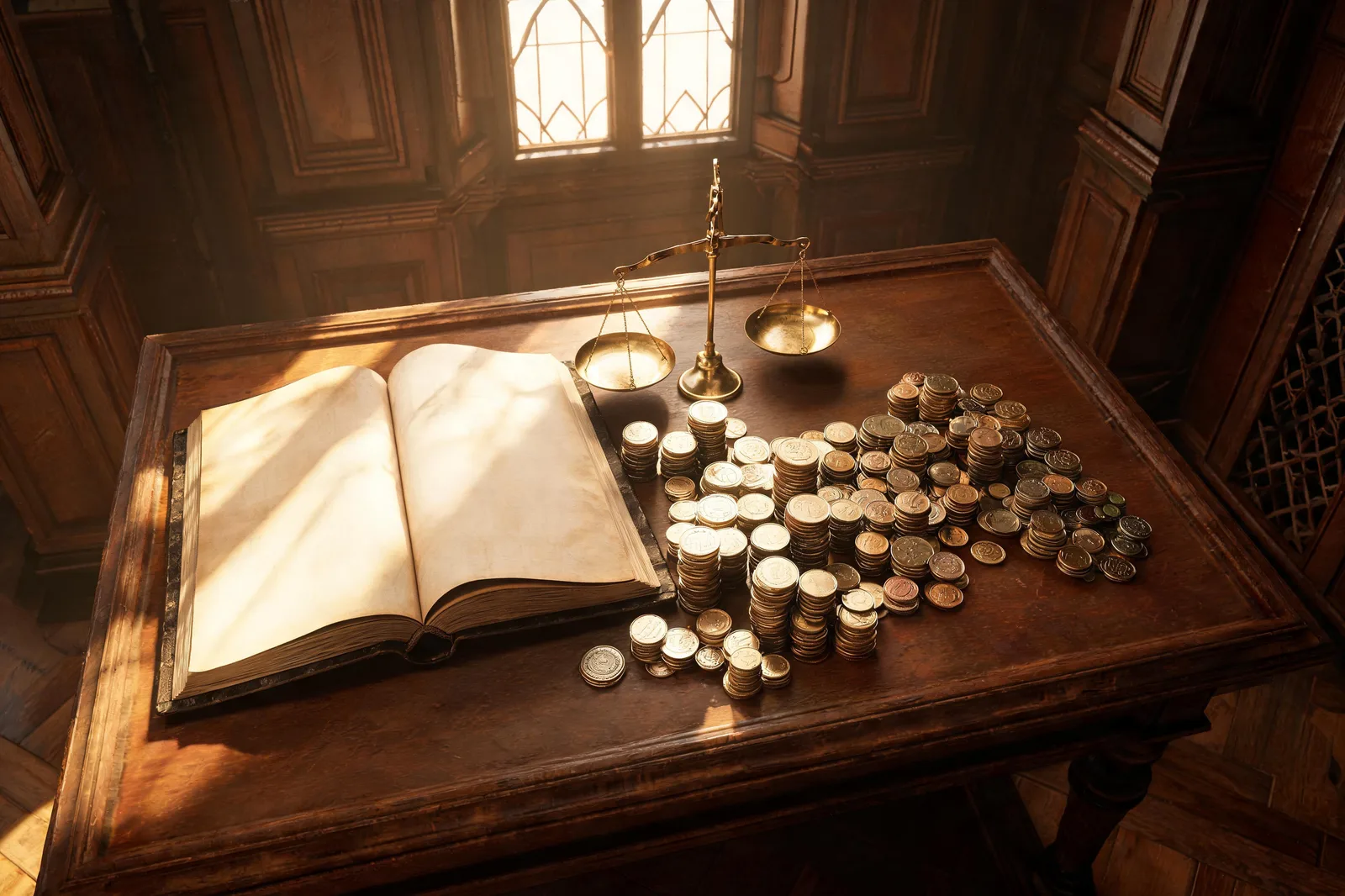
Why would a tarot deck take its name from a single scene printed on one trump card? The austrian tarock game answers with Vienna's own pattern, known informally as Industrie und Glück, "industry and luck," after the genre scene printed on its twenty-first trump. Unlike the Italian and French decks covered earlier in this series through Church Sermons Against the Trumps in the Fifteenth Century, the Austrian pattern dropped esoteric or allegorical trumps entirely and replaced them with everyday Viennese life: markets, workshops, travellers, ordinary people going about ordinary business.
A Viennese pattern of its own
By the eighteenth century, cardmakers across German-speaking Europe had developed their own regional variants of the trionfi game that had spread north from Italy over the preceding centuries. The Viennese pattern that became standard, printed and reprinted for generations by firms that eventually consolidated into manufacturers such as Piatnik, replaced the old trump imagery, the Fool, the Wheel, the Hanged Man, with a sequence of numbered scenes showing trades, travel and daily labour. Tradition holds that the pattern took shape around the mid-eighteenth century, though the exact workshop and year of its first printing remain debated among collectors and card historians, since early decks were rarely dated or signed.
The scene that named the deck
Trump twenty-one in the Viennese pattern depicts a scene showing both commerce and chance together, often read as a lottery office or a merchant's counting room, captioned Industrie und Glück. That single card's title became the informal name for the entire pattern, the way some decks are named after their printer rather than their imagery. The choice of subject fits the deck's whole approach: no angels, no devils, no hierophants, just the ordinary machinery of getting by, applied as the top-ranking trump in a card game rather than as a philosophical statement. German-speaking card players kept using this very down-to-earth imagery for centuries, long after French and Italian decks had already been pulled into occult reinterpretation.
Printers who kept the pattern alive
Manufacturers such as Piatnik, founded in Vienna in the nineteenth century, printed the Industrie und Glück pattern for domestic players long after France and England had moved on to new interpretations of the trumps. The firm's catalogue still lists tarock decks today, alongside ordinary playing cards and board games, treating the pattern as standard household stock rather than a specialty or revival item. That commercial continuity is itself telling: a deck stays in ordinary print only while people keep buying it to play with, not to study.
Rules built for the austrian tarock game
The austrian tarock game is still played today, chiefly in the form called Königrufen, "calling the king," a three or four-player trick-taking game using the full Industrie und Glück pack. Players bid for the right to name a contract, call a partner by naming a king they do not hold themselves, and then try to win tricks carrying bonus points, with the lowest trump, called the Pagat, prized for the risk of playing it well. The game's rules are intricate enough that regional clubs across Austria still run active leagues and championships, treating tarock the way some countries treat bridge: a serious card game with a developed competitive culture, not a historical curiosity.
Not the Thoth deck's ancestor
It would be a mistake to read the Austrian pattern as a step toward the symbolic density of the Thoth deck. It moved the opposite direction, stripping the trumps of any allegorical reading at all in favour of charming, secular genre scenes. Readers who know only the heavily correspondence-laden Thoth trumps, The Hierophant among them, may be surprised that an entire branch of the tarot's European history simply walked away from symbolism and toward illustrated card-table entertainment. That branch never stopped: Austrian, Hungarian and other Central European tarock variants remain active games today, printed by the same companies that make ordinary playing cards, sold beside them in the same shops.
A living counter-example
The Industrie und Glück pattern is useful precisely because it resists the story the rest of this series keeps circling back to: that the tarot's trajectory ran steadily toward esoteric reinterpretation after the 1780s. Vienna's card players took the opposite route and never looked back, keeping a seventy-eight card pattern purely as a game while France built an entire occult literature on a deck structurally nearly identical to it. The Wikipedia overview of Tarock lays out the variant rules still played across Central Europe for anyone curious how differently the same basic deck can be used.
Two destinies, one deck
Side by side, the Austrian tarock and the Thoth deck make an unusually clean case study: identical ancestry, opposite outcomes. One modernised by staying a game, redrawing its trumps as scenes of ordinary industry and luck; the other transformed into a dense symbolic instrument built for contemplation rather than trick-taking. Neither path was inevitable. Both were choices made by the people who kept printing, playing and reinterpreting a shared deck, city by city, decade by decade.
Questions
What is the austrian tarock game?
A trick-taking card game played with the Industrie und Glück pattern deck, whose trumps show scenes of everyday Viennese trade and travel instead of allegorical figures.
Why is the deck called Industrie und Glück?
Its twenty-first trump shows a scene captioned "industry and luck," depicting commerce and chance together, and the title became the pattern's informal name.
What is Königrufen?
"Calling the king," the most common tarock variant, where a player bids for a contract and calls a partner by naming a king they do not hold.
Is Austrian tarock related to the occult tarot?
It shares the same seventy-eight card ancestry but moved the opposite direction, keeping the trumps secular while French and English decks turned esoteric.
This article talks about
You might also like
 Symbolism
 Symbolism
 Symbolism
© 2026 TAROTS chat (tarots.chat). All rights reserved. No part of this article may be reproduced, distributed or adapted without the owner's written permission.
The Journal
 Thoth Tarot
 Love
 Love
 Thoth Tarot
 Kabbalah
 Love
 Symbolism
 Symbolism
 Kabbalah