Eliphas Levi Summons Apollonius in London
by Redazione · 9 October 2026 · 5 min read
A Frenchman, a London townhouse, and a ghost
The Éliphas Lévi Apollonius story is tarot history's best piece of evidence that even its most sober theorist had one genuinely strange night in him. In 1854, the French occultist, born Alphonse Louis Constant and already the author who would soon link the Hebrew alphabet to the Major Arcana, travelled to London at the invitation of an Englishwoman interested in magic, whom he describes in his own writing without naming fully. She asked him to perform an actual evocation, calling up the spirit of the first-century philosopher Apollonius of Tyana rather than simply discussing theory over tea, and Lévi, by his own account, agreed to try.
Fasting, a locked room, and careful instructions
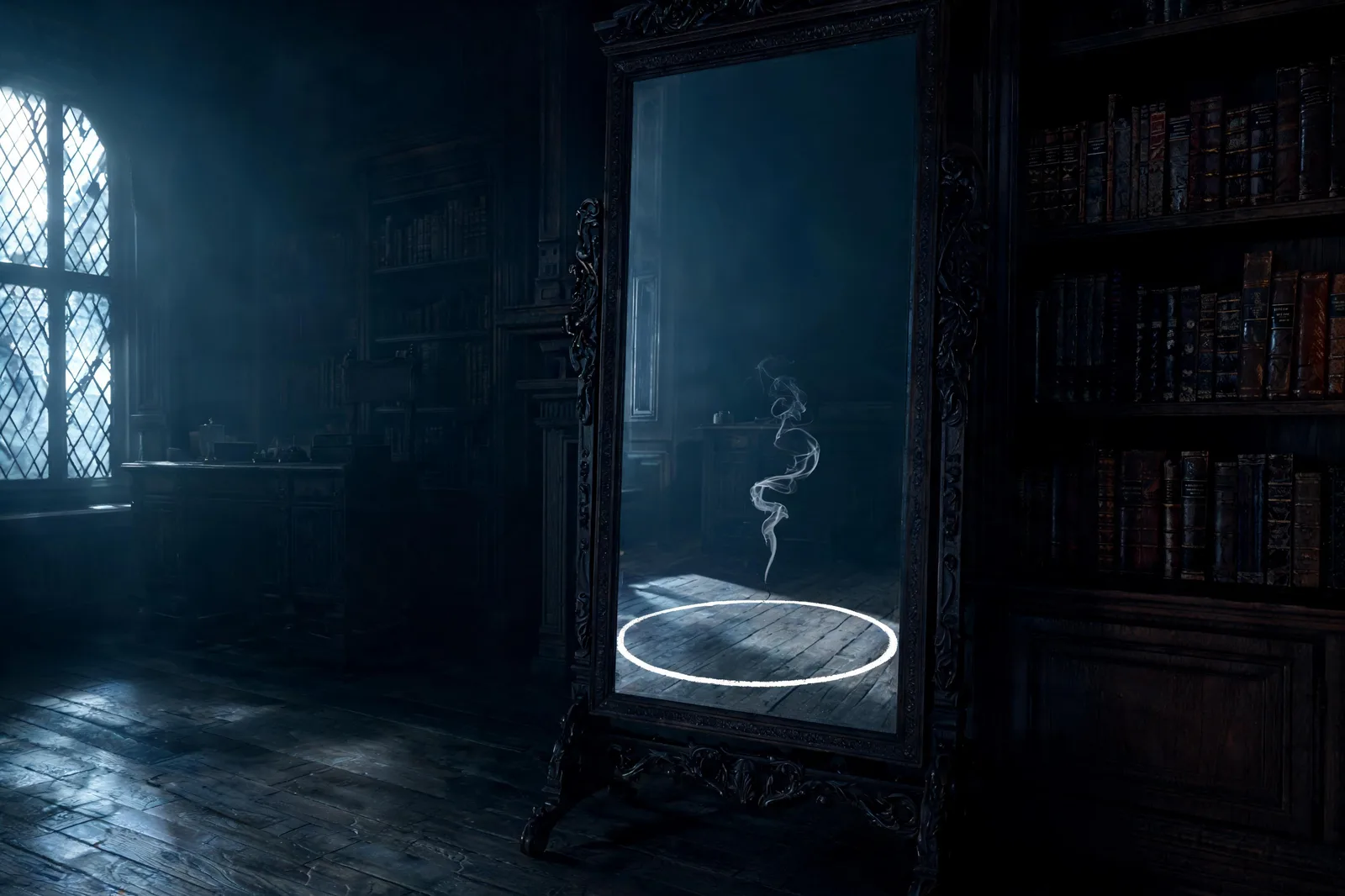
Tradition holds, mostly from Lévi's own retelling in Dogme et Rituel de la Haute Magie, that he prepared for several days beforehand with fasting and restricted sleep, a regimen he considered necessary groundwork rather than theatre. The ritual itself took place in a room specially prepared with mirrors, a small altar and the kind of ceremonial furniture any reader of his later books on the tarot and the Hebrew letters would recognise as his usual symbolic apparatus. He drew the protective figures he describes elsewhere in his tarot writing, the same tradition that underlies Éliphas Lévi's School: The Tarot as a Universal Key, and set about the actual evocation alone, inside a circle, by candlelight, long after midnight.
What he says he saw
By Lévi's own account, a figure appeared, pale, shrouded and unmistakably strange, and he felt an icy touch on his arm that reportedly left it numb for some time afterward, a detail he repeats with notable restraint for a man otherwise given to dramatic prose. He does not claim a dramatic conversation with a speaking ghost; the story goes that the apparition was brief, silent in any conventional sense, and over almost before he could fully register it. What makes the anecdote more interesting than a simple ghost story is Lévi's own hedging immediately afterward: he openly entertains the possibility that exhaustion, fasting and suggestion produced the vision, rather than insisting on a literal spirit, a surprisingly careful qualification from a man selling the public on the reality of ceremonial magic.
Why this story sits oddly in tarot history
Lévi is remembered by tarot readers chiefly for pairing the twenty-two Hebrew letters with the twenty-two trumps, the correspondence system explored in more technical detail in Where the Twenty-Two Letters Come From: Lévi's 1856 Attribution, and for insisting that The Fool and the rest of the deck encoded a complete philosophical system rather than a parlour game. The London evocation rarely gets equal space in that discussion, perhaps because it is harder to footnote than a letter correspondence table, yet it is arguably the moment that best shows how Lévi actually understood magic: not as pure symbol-reading from an armchair, but as something he was willing to test, at personal cost, with his own body and nerves on the line in a borrowed London room.
The patroness nobody can quite name
One detail that has drifted into genuine uncertainty is exactly who invited him. Lévi's own text is coy about her identity, and later writers have proposed various candidates among London's circle of wealthy, magic-curious Englishwomen of the period, without any claim rising to settled fact. The honest position, repeated by careful historians of the episode, is that we know an invitation happened, we know Lévi accepted it and performed the ritual as described, and we do not have a fully verified name to attach to the woman who arranged it. Treat any confident identification offered elsewhere online with some suspicion; this is one of the places where the anecdote is more solid than the footnote.
A ritual built from borrowed pieces
Lévi was never shy about his sources, and the London ritual shows it. He drew on ceremonial elements he associated with older grimoire traditions and with the Hermetic Qabalah he was busy weaving into his own system at the time, the same intellectual habit that later let the Golden Dawn fold his tarot correspondences into a much larger curriculum. He treated the evocation less as an improvised séance and more as an engineering problem: the right fast, the right hour, the right geometry on the floor, as if magic were a procedure that simply had to be followed correctly rather than an art requiring improvisation. That procedural mindset is easy to miss when later readers focus only on the eerie outcome, but it is consistent with everything else he wrote about ceremonial practice, including his insistence that the tarot itself rewarded careful, structured study rather than loose intuition.
The part that still makes readers smile
What keeps the story in circulation, beyond its spookiness, is the mismatch between Lévi's reputation as a dense, allegorical theorist and the plain, almost deadpan practicality of his account: fast for days, draw the right shapes, stand in the circle, and report honestly on an experience you cannot fully explain, numb arm and all. It is a rare moment where one of the tarot's foundational nineteenth-century writers steps out from behind the correspondence tables and the Hebrew letters and simply tells a ghost story about himself, hedged carefully enough that a modern reader can take it exactly as seriously as they like.
Readers wanting Lévi's own framing of the episode, alongside his wider magical theory, can consult the Éliphas Lévi Wikipedia entry for sourced biographical detail.
Questions
What did Eliphas Levi claim happened in the London evocation?
He wrote that a pale, shrouded figure appeared after days of fasting and ritual preparation, and that he felt an icy touch leaving his arm numb, though he stopped short of insisting it was a literal spirit.
Who invited Eliphas Levi to perform the ritual?
An Englishwoman interested in magic, whom Levi does not fully name in his own account. Her exact identity remains unverified despite various later guesses.
Is the Apollonius evocation connected to Levi's tarot work?
Indirectly. The same ceremonial framework and symbolic discipline underlie his better-known pairing of the Hebrew letters with the tarot trumps, though the evocation itself is a separate episode.
Did Eliphas Levi believe the vision was real?
He left the question open, acknowledging that fasting, sleep deprivation and suggestion could have produced the experience, rather than asserting it was unquestionably a genuine spirit.
This article talks about
You might also like
 Tarot Journal
 Tarot Journal
 Tarot Journal
© 2026 TAROTS chat (tarots.chat). All rights reserved. No part of this article may be reproduced, distributed or adapted without the owner's written permission.
The Journal
 Kabbalah
 Major Arcana
 Love
 Love
 Major Arcana
 Tarot Journal
 Symbolism
 Symbolism
 Kabbalah