John Dee, Enochian Magic and the Golden Dawn
How a sixteenth-century angelic system reached the four tarot suits
by Redazione · 9 October 2026 · 5 min read
A language received, not invented
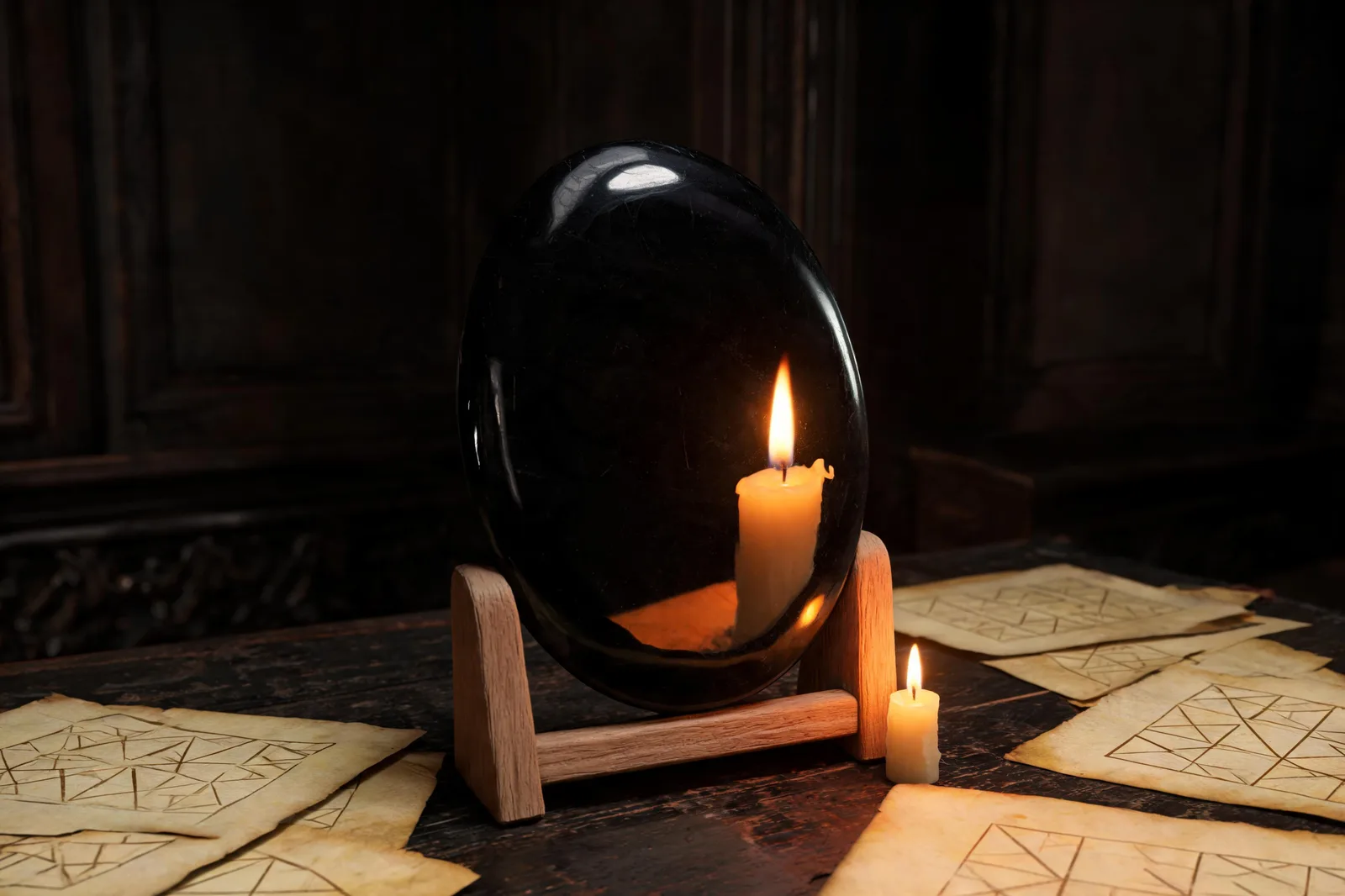
Enochian magic is the system of angelic communication that the Elizabethan mathematician and astrologer John Dee, working with the medium Edward Kelley, recorded between 1582 and 1589 through a series of scrying sessions using a polished obsidian mirror. Dee believed Kelley was transcribing a genuine angelic language, complete with its own grammar, alphabet and a set of grids called the Watchtowers, through which the whole created order could supposedly be addressed and known. He never called it "Enochian"; that name came later, from the Biblical patriarch Enoch, said to have walked with angels before the Flood. The previous article in this series followed Agrippa's ladder of worlds through Agrippa's Three Books of Occult Philosophy; Dee, a serious reader of Agrippa, pushed that same project toward direct angelic contact rather than theory alone.
What makes the episode remarkable is not only its content but its character: Dee kept meticulous diaries, dated and cross-referenced, of sessions he clearly regarded as careful empirical research into a real spiritual order.
Who John Dee actually was
John Dee was not a fringe figure. He advised Elizabeth I, owned one of the largest private libraries in England, and worked seriously in mathematics, navigation and astrology at a time when these were not yet separate disciplines. His scrying sessions with Kelley took place during a difficult period of his life, after his scholarly ambitions had stalled, and the angelic conversations promised exactly what conventional learning had failed to deliver: a direct, unmediated route to complete knowledge. Kelley, whose own reliability modern historians doubt considerably more than Dee's contemporaries did, supplied the visions; Dee supplied the careful transcription and mathematical cross-checking that gave the whole system its unusually systematic shape.
Nothing from this period mentions tarot cards. The connection was made centuries later, by readers who found Dee's elaborate angelic hierarchy too useful a structure to leave unused. Dee died in poverty, his library scattered and his reputation badly damaged by the whole episode, long before anyone thought to connect his angelic diaries to a deck of playing cards.
How the Golden Dawn absorbed it
The Hermetic Order of the Golden Dawn rediscovered Dee's manuscripts in the British Museum in the 1880s and rebuilt Enochian material into its own elemental teaching, particularly the four Watchtowers, each assigned to one of the four elements and, by extension, to one of the four tarot suits. This is the most direct and lasting link between Dee's angelic system and the deck a modern reader holds: Ace of Swords — Root of the Powers of Air, rooted in the element of air, carries an Enochian inheritance passed down through exactly this nineteenth-century reconstruction, however loosely it sits on Dee's own original intentions. The order also drew Enochian names into its initiation rituals and its system of pathworking, treating the angelic language as a genuine key to inner travel between the spheres of the Tree of Life.
Members were taught to vibrate Enochian names aloud as part of ritual practice, convinced that the sounds themselves, not only their meaning, carried real force. This elemental scheme later passed, largely intact, into the Thoth deck's own correspondences, giving every Minor Arcana card an inherited place within Dee's reconstructed angelic geography, whether or not the reader ever learns a single Enochian word.
Scholarly doubt and continued use
Historians of science generally treat the Enochian episode as a serious case of self-deception, likely compounded by Kelley's own fabrications, rather than genuine angelic contact. That judgement has not stopped the system's long afterlife. Aleister Crowley, trained inside the Golden Dawn's Enochian framework before his break with the order, later used it extensively in his own magical diaries, including his systematic exploration of the thirty Enochian Aethyrs. The material's sheer internal complexity, a full alphabet, a working grammar, elaborate hierarchies, gave it a texture that simpler invented systems rarely achieve, which is likely why it kept being taken up rather than quietly discarded.
What a reader keeps from Dee's angelic records
A modern reader of the Thoth deck rarely needs to know Enochian grammar to use the cards, but the elemental attributions a reading relies on, air to swords, fire to wands, and so on, pass through this specific nineteenth-century reconstruction of a sixteenth-century project. Tradition holds that Dee himself would have been startled to find his careful angelic diaries repurposed as a card reader's elemental key, a use he never imagined and could not have anticipated.
The next article in this series turns from angelic language to Gnostic myth, tracing its themes through the Aeon and the Star.
FAQ
Did John Dee invent the Enochian language himself? No. He believed Edward Kelley was receiving it directly from angels; Dee's own role was recording, cross-checking and systematising what Kelley reported.
Why is it called "Enochian"? The name references the Biblical patriarch Enoch, said to have received angelic knowledge; Dee and Kelley themselves used other terms for the material.
How does Enochian magic connect to the tarot? Mainly through the Golden Dawn's four Watchtowers, which it mapped onto the four elements and, by extension, onto the four tarot suits.
Do scholars think Enochian magic was genuine angelic contact? Most historians treat it as sincere self-deception on Dee's part, likely shaped by deception, conscious or not, on Kelley's.
Questions
Did John Dee invent the Enochian language himself?
No. He believed Edward Kelley was receiving it directly from angels; Dee's own role was recording, cross-checking and systematising what Kelley reported.
Why is it called "Enochian"?
The name references the Biblical patriarch Enoch, said to have received angelic knowledge; Dee and Kelley themselves used other terms for the material.
How does Enochian magic connect to the tarot?
Mainly through the Golden Dawn's four Watchtowers, which it mapped onto the four elements and, by extension, onto the four tarot suits.
Do scholars think Enochian magic was genuine angelic contact?
Most historians treat it as sincere self-deception on Dee's part, likely shaped by deception, conscious or not, on Kelley's.
This article talks about
You might also like
 Spirituality
 Spirituality
 Spirituality
© 2026 TAROTS chat (tarots.chat). All rights reserved. No part of this article may be reproduced, distributed or adapted without the owner's written permission.
The Journal
 Thoth Tarot
 Kabbalah
 Thoth Tarot
 Kabbalah
 Disks
 Symbolism
 Symbolism
 Kabbalah