How to Read the Celtic Cross Tarot Spread
Ten positions, one clear order: what each card in the Celtic Cross actually answers.
If you want to know how to read the Celtic Cross tarot spread, the short answer is: in a fixed order, because each of its ten positions asks a different question, and reading them out of order is the single most common reason the spread feels confusing. Card one is not "more important" than card ten — it answers a different thing entirely, and the layout only makes sense once you treat it as ten questions asked in sequence rather than one large picture read all at once.
Where the spread actually comes from
The Celtic Cross was first published as a diagram by A. E. Waite in The Pictorial Key to the Tarot (1910), where he presented it under the name "An Ancient Celtic Method of Divination." Its real origin is older and less certain: Waite was a member of the Hermetic Order of the Golden Dawn, and spreads close to this one were already circulating inside the order before his book put one into print for a general readership. So the honest version of its history is that Waite is the first source we can point to, not necessarily the inventor — and the spread has been the default full reading in English-language tarot ever since, sometimes called "the mother of all tarot spreads."
How to read the Celtic Cross tarot spread: the ten positions in order
- The situation — the heart of the matter as it stands right now, sometimes called the significator.
- The challenge — laid across the first card; what is crossing, complicating or pressuring the situation.
- The foundation — the distant past or the deeper cause the situation is built on.
- The recent past — what has just happened, or what is now passing out of the picture.
- The crown — the best outcome available, or the conscious goal the person is reaching for.
- The near future — what is coming next, on a fairly short horizon.
- Your stance — how the person is showing up: their attitude, fears or self-image in the matter.
- The environment — other people, circumstances or outside forces acting on the situation.
- Hopes and fears — often the same card doing double duty, since the two are frequently tangled together.
- The outcome — where things are heading if nothing changes course.
Cards one and two sit crossed in the centre; three through six form a vertical line beside them (foundation at the bottom, crown at the top, recent past and near future to either side); seven through ten stack in a column, usually to the right, read bottom to top from stance up to outcome.
Reading it as a sequence, not a snapshot
Start at the centre, not the edges. Read the situation and the challenge together first — that pair alone is often a complete short answer on its own, which is worth noticing, since some readers stop there for a quick question and use the full ten only for something that deserves the depth.
From there, move outward: foundation and recent past explain how the present situation got built, crown and near future show where it's headed if the current momentum holds. The right-hand column then turns the same story inward, from the person's own stance out to the wider environment and finally to a probable outcome.
Treat position ten as a likely direction, not a verdict. It describes where things are heading if nothing in positions one through nine changes — and naming what would need to change is usually the more useful reading than the outcome card by itself.
A short example
Say The Hermit lands in the stance position and Fortune lands in the near future — the same The Wheel of Fortune Tarot Card Meaning in the Thoth Deck discussed on its own: read together, that is someone who has been withdrawing to think things through, about to meet a change that is arriving faster than their current pace of reflection. Neither card alone says that; the position each one occupies is doing most of the work, which is exactly why the Celtic Cross rewards reading position by position rather than scanning all ten cards for a general impression.
When to use the Celtic Cross, and when not to
Ten cards is a lot for a narrow question. "Should I take this specific job offer" usually reads more clearly with a three-card spread — situation, action, outcome — because ten positions on a small question tend to produce noise rather than clarity. The Celtic Cross earns its size on genuinely layered questions: a relationship at a turning point, a life direction, a pattern that has repeated for years and needs to be seen whole. If your question is that size, Celtic Cross is worth the full ten positions; if it is not, a smaller spread will usually serve the actual question better.
Frequently asked questions
How do you read the Celtic Cross tarot spread in order? Start at the centre with the situation and challenge, move through the vertical line for foundation, recent past, near future and crown, then read the right-hand column from the person's stance up to the final outcome.
Who invented the Celtic Cross spread? Its true origin is unclear. A. E. Waite was the first to publish a diagram of it, in The Pictorial Key to the Tarot (1910), though similar layouts were already used inside the Golden Dawn before that.
Is the tenth card in the Celtic Cross a fixed outcome? No. It describes where things are heading if the situation continues on its current course, not a fixed fate — the earlier positions usually show what would change it.
What's the difference between the hopes and fears position and the outcome? Hopes and fears describes what the person wants and dreads at once, often the same card doing both jobs; the outcome describes the likely direction the whole situation is taking, independent of what the person wishes for.
Is the Celtic Cross a good spread for beginners? It's a fine spread to learn from, but a smaller three-card spread is usually easier for a first reading, since ten positions ask a beginner to hold a lot of structure in mind at once.
Frequently asked questions
How do you read the Celtic Cross tarot spread in order?
Start at the centre with the situation and challenge, move through the vertical line for foundation, recent past, near future and crown, then read the right-hand column from the person's stance up to the final outcome.
Who invented the Celtic Cross spread?
Its true origin is unclear. A. E. Waite was the first to publish a diagram of it, in The Pictorial Key to the Tarot (1910), though similar layouts were already used inside the Golden Dawn before that.
Is the tenth card in the Celtic Cross a fixed outcome?
No. It describes where things are heading if the situation continues on its current course, not a fixed fate — the earlier positions usually show what would change it.
What's the difference between the hopes and fears position and the outcome?
Hopes and fears describes what the person wants and dreads at once, often the same card doing both jobs; the outcome describes the likely direction the whole situation is taking, independent of what the person wishes for.
Is the Celtic Cross a good spread for beginners?
It's a fine spread to learn from, but a smaller three-card spread is usually easier for a first reading, since ten positions ask a beginner to hold a lot of structure in mind at once.
This article talks about
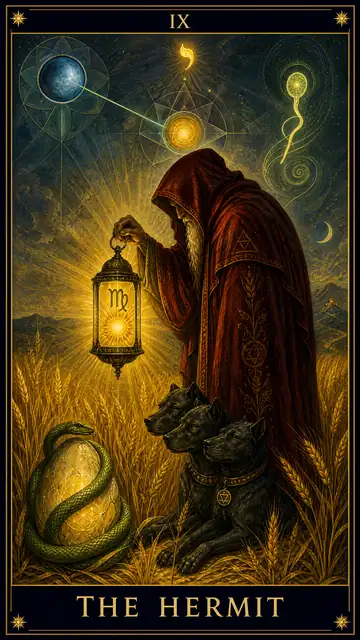 The Hermit
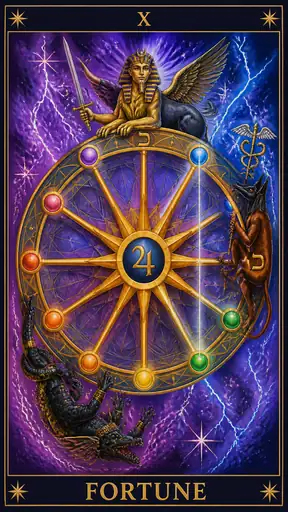 Fortune
Share this article
You might also like
The Wheel of Fortune Tarot Card Meaning in the Thoth Deck
Kaph, Jupiter and path 21: why Crowley just calls it Fortune, and what changes when the wheel turns.
How to Read Tarot Cards: A Beginner's Guide
Suits, positions and one simple three-card spread to get you reading with real instinct, not memorized definitions.
Tarot Spreads for Career Decisions
A four-card spread for a specific choice, and when to use the wider Horseshoe instead.