Tarot and Kabbalah: How the 22 Trumps Became the Hebrew Letters
From a 1781 Paris essay to the Thoth deck: the Sefer Yetzirah, the Tree of Life and why the system fits so well
by Redazione · 6 October 2026 · 8 min read
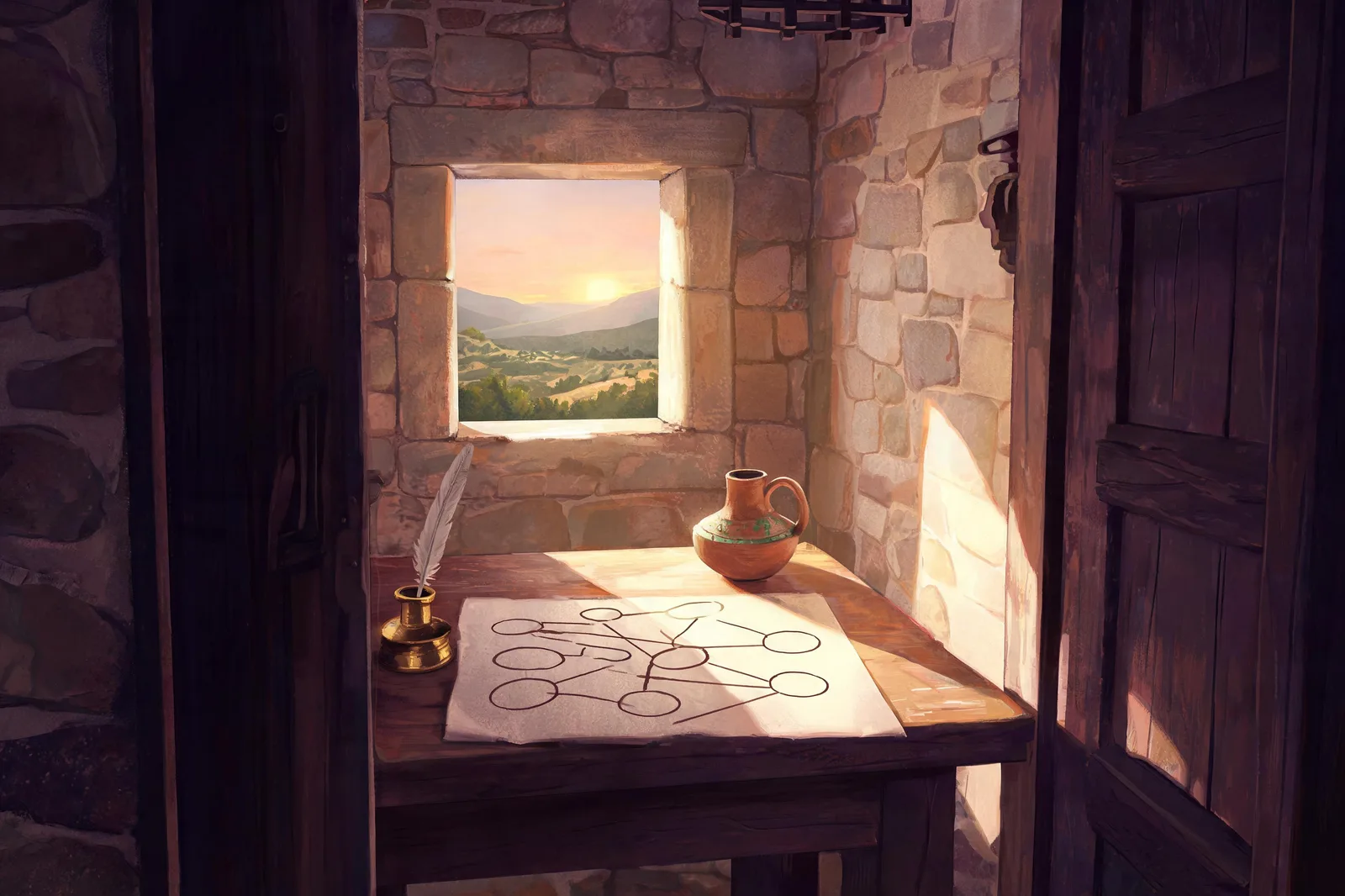
Tarot and Kabbalah are bound together by one number: twenty-two. The tarot has twenty-two trumps, the Major Arcana, and the Hebrew alphabet has twenty-two letters. Since the eighteenth century, occultists have read each trump as one letter and set all twenty-two on the paths of the Kabbalistic Tree of Life. This guide explains where that link came from, how it works card by card, and why the Thoth Tarot is built on it from the first trump to the last small card.
The short version: the link between tarot and Kabbalah is a modern construction, not an ancient secret. It is still one of the most coherent symbolic systems in Western esotericism. Knowing how it was built makes your readings deeper, not weaker.
Where the link between tarot and Kabbalah began
The tarot was born in fifteenth-century Italy as a card game called trionfi, played at courts like those of the Visconti and Sforza in Milan. Nothing in those early decks points to Hebrew letters or Jewish mysticism.
The bridge appears much later, in Paris. In 1781 Antoine Court de Gébelin published volume eight of his encyclopaedic Le Monde primitif. It claimed that the tarot preserved the lost wisdom of ancient Egypt. The same volume carried an essay by the Comte de Mellet, who called the cards the Book of Thoth and first matched the twenty-two trumps with the twenty-two Hebrew letters. Neither claim was based on evidence, but the idea took hold.
In 1856 the French magus Éliphas Lévi made it systematic in Dogme et Rituel de la Haute Magie. He gave Aleph to the Magician and slipped the Fool in near the end, at the letter Shin. At the end of the century the Hermetic Order of the Golden Dawn in London rebuilt the scheme. It moved The Fool to the front as Aleph and gave every trump a path, an element, a planet or a zodiac sign. That is the scheme Aleister Crowley and Lady Frieda Harris painted into the Thoth deck between 1938 and 1943.
Three spellings mark the three traditions. Kabbalah is the Jewish mystical tradition of medieval Provence and Spain, of the Zohar and Isaac Luria. Cabala is the Christian adaptation of the Renaissance. Qabalah usually means the Hermetic system of the Golden Dawn. The tarot belongs to the third. Jewish Kabbalah itself has no tarot tradition, and it is honest to say so.
The Sefer Yetzirah: the key to the twenty-two trumps
Why does the scheme hold together so well? Because it rests on a short, very old Hebrew text, the Sefer Yetzirah, the "Book of Formation". It describes creation through "thirty-two wonderful paths of wisdom": ten sefirot, the numbers or emanations, and twenty-two letters. The Sefer Yetzirah also divides the letters into three groups, and each group rules part of the world:
- Three mother letters, Aleph, Mem and Shin, carry the elements Air, Water and Fire.
- Seven double letters, Beth, Gimel, Daleth, Kaph, Peh, Resh and Tav, carry the seven classical planets.
- Twelve simple letters carry the twelve signs of the zodiac.
Lay the trumps on these letters and the cards fall into the same three families. That is the strongest relation between tarot and Kabbalah: the structure of the deck mirrors the structure of the book.
- The three mothers become the three elemental trumps. The Fool is Aleph and Air, the breath before anything is formed. The Hanged Man is Mem and Water, the surrender of the drowned god. The Aeon is Shin and Fire, the flame of a new age.
- The seven doubles become the planetary trumps. The Magus is Beth and Mercury, the High Priestess Gimel and the Moon. The Empress is Daleth and Venus, the Wheel of Fortune Kaph and Jupiter. The Tower is Peh and Mars, the Sun Resh and the Sun, and The Universe Tav and Saturn.
- The twelve simples become the zodiac trumps, from The Emperor in Aries to the Moon in Pisces.
Each card is therefore a letter, a path between two sefirot and a cosmic force at the same time. The Golden Dawn did not invent that structure; it borrowed it from a text more than a thousand years older than the cards.
The Tree of Life: paths, sefirot and the whole deck
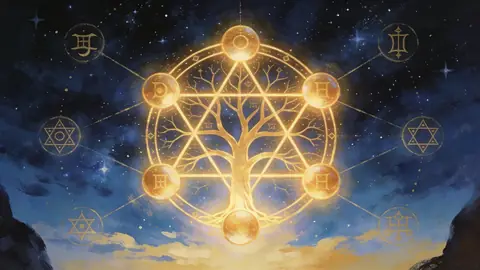
The Tree of Life used by tarot readers is a diagram of ten circles, the sefirot, joined by twenty-two lines, the paths. The version almost everyone knows was published by the Jesuit scholar Athanasius Kircher in Oedipus Aegyptiacus (1652–1654), the first Tree with a Hebrew letter on every path. The Golden Dawn adopted Kircher's Tree. Our Tarot Tree of Life: A Qabalah Primer primer walks through it sefirah by sefirah.
On that map the whole deck has a place, not only the trumps:
- The 22 trumps are the paths: journeys between two states of being. The Tower path joins Netzach (victory, feeling) to Hod (splendour, intellect), and it crosses the Tree like lightning.
- The 40 small cards are the sefirot. Every Ace sits in Kether, the crown. The Twos sit in Chokmah, the Threes in Binah, and so on down to the Tens in Malkuth, the kingdom. A Five of any suit carries the severity of Geburah; a Six carries the harmony of Tiphareth.
- The four suits are the four worlds. Wands are Atziluth, the world of will and fire. Cups are Briah, creation and water. Swords are Yetzirah, formation and air. Disks are Assiah, action and earth. A Six of Disks is the harmony of Tiphareth expressed in the material world.
- The 16 court cards are the divine name YHVH. In the Thoth deck the Knight is Yod and fire, the Queen the first He and water, the Prince Vav and air, the Princess the final He and earth.
So one card in a spread is never alone. It points to a letter, a place on the Tree, a world and an element. The Golden Dawn Tarot Correspondences Explained guide lists the full tables.
Hebrew letters and tarot in the Thoth deck: Tzaddi is not the Star
Crowley kept the Golden Dawn scheme with one famous change. In 1904 he received The Book of the Law, which contains the line "Tzaddi is not the Star". He took it as an instruction. In the Thoth deck The Star receives He, and The Emperor receives Tzaddi: the two trumps exchange letters.
The paths on the Tree do not move, so the swap creates a small loop. Crowley compared it to the twist that already joins Strength and Justice in the Golden Dawn order, which he renamed Lust (XI) and Adjustment (VIII). The two exchanges mirror each other, one in Aries and Aquarius, one in Leo and Libra. Crowley read this as a sign that the scheme was alive, not a fixed catalogue. You can follow his reasoning in our Aleister Crowley's Book of Thoth Explained article.
How to use Kabbalah in your tarot readings
You do not need Hebrew or a diagram on the wall to use any of this. Three habits are enough.
- Read the number of a small card as a sefirah. Every Seven, the sefirah of Netzach, speaks of feelings that run ahead of reason. Every Eight, Hod, speaks of method and the mind.
- Read a trump as a path between two states. Ask where the querent stands and where the path leads. The Hermit, on the path of Yod, goes from the heart of the Tree, Tiphareth, up towards Chesed, mercy.
- Read the suits as levels of the same story. When Wands and Disks dominate, the question moves from will to matter. When Cups and Swords dominate, it lives in feeling and thought.
A Celtic Cross read this way gains a second layer of meaning without losing the first. If you want to practise, you can draw a Celtic Cross on TAROTS chat and ask the reader to explain the Kabbalistic place of each card.
A living system, not an ancient secret
Is the tarot "really" Kabbalistic? Historically, no: the cards came first, and the Kabbalah was mapped onto them three centuries later. Symbolically, the fit is remarkable. Twenty-two letters in three families matched twenty-two trumps, ten sefirot matched ten numbered cards, and four worlds matched four suits. Few systems built by many hands fit together this well.
That is why the Thoth Tarot still rewards study. Each card opens onto a letter, a path and a world, and together they describe one journey from the crown of the Tree to the kingdom, and back.
Questions
Is the tarot originally Kabbalistic?
No. The tarot began as a card game in fifteenth-century Italy. The link with the Hebrew letters was first proposed in 1781 in Court de Gébelin's Le Monde primitif and developed by Éliphas Lévi and the Golden Dawn.
Which Hebrew letter goes with which tarot card?
In the Golden Dawn and Thoth system the Fool is Aleph, the Magus is Beth, and so on through the alphabet to the Universe, which is Tav. Crowley swapped two: in the Thoth deck the Star is He and the Emperor is Tzaddi.
What is the Sefer Yetzirah?
A short early Hebrew text on creation through 32 paths of wisdom: ten sefirot and 22 letters. Its division of the letters into 3 mothers, 7 doubles and 12 simples gives the tarot trumps their elements, planets and zodiac signs.
Where do the minor arcana fit on the Tree of Life?
Each number sits on one sefirah, from the Aces in Kether to the Tens in Malkuth, and each suit belongs to one of the four worlds: Wands to Atziluth, Cups to Briah, Swords to Yetzirah and Disks to Assiah.
This article talks about
You might also like
 Kabbalah
© 2026 TAROTS chat (tarots.chat). All rights reserved. No part of this article may be reproduced, distributed or adapted without the owner's written permission.
The Journal
From the Journal
Chosen for this page
 Kabbalah
Sefer Yetzirah Tarot: Traces of the Trumps in the Book of Formation
7 min read
More in Kabbalah Kabbalah
Tarot and String Theory: Ten Dimensions, Vibration and the Tree of Life
8 min read
More in Kabbalah Kabbalah
Atziluth Tarot: The World of Emanation, Fire and the Suit of Wands
6 min read
More in Kabbalah Kabbalah
 Kabbalah
 Kabbalah
 Kabbalah
 Kabbalah