The Princess of Swords: Earth of Air
by Redazione · 9 October 2026 · 5 min read
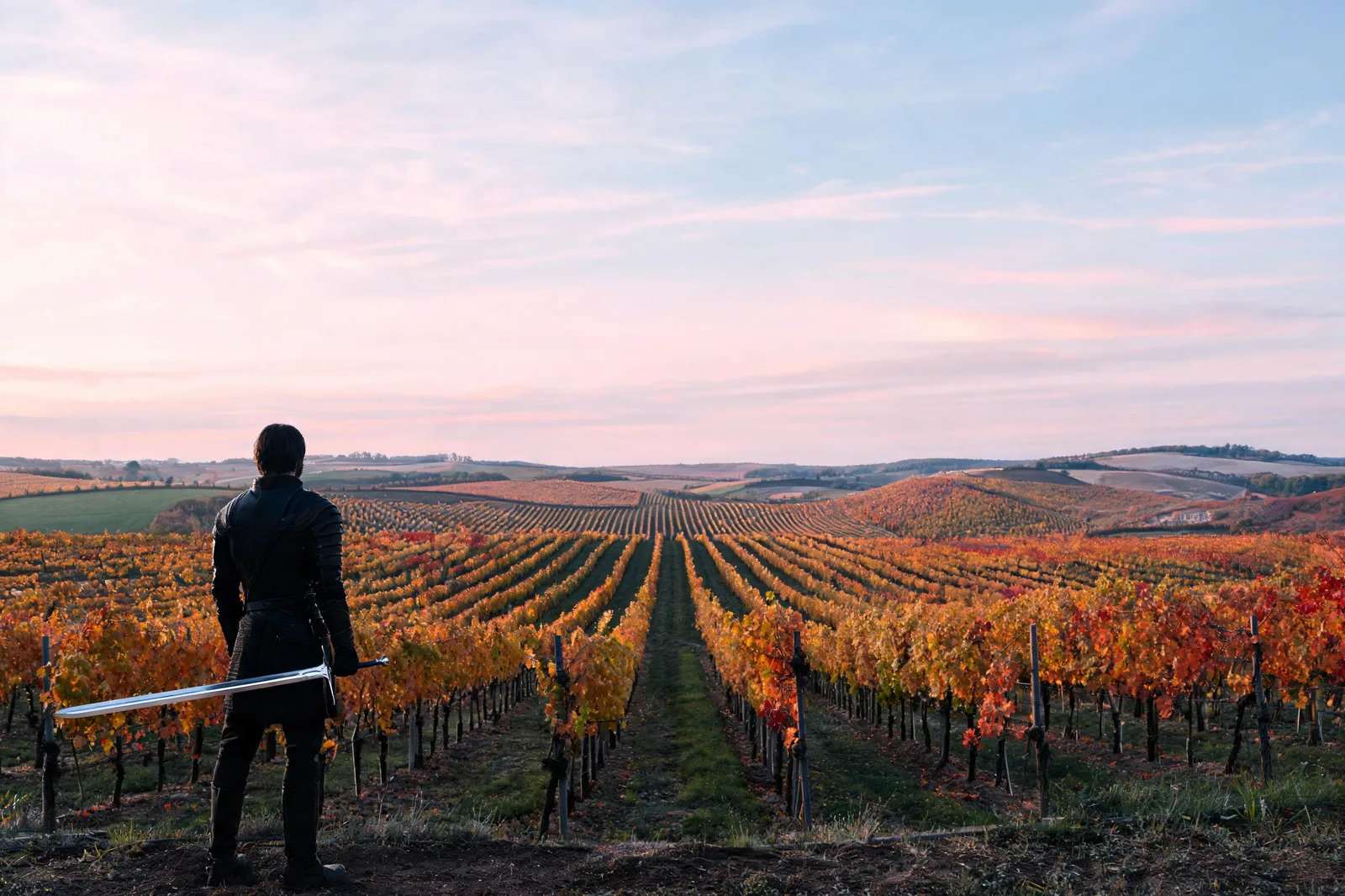
The Princess of Swords carries the title Earth of Air, and after The Ten of Swords, Ruin: Sun in Gemini closed the suit's small cards at their lowest point, the princess of swords card opens something different entirely: not another decan, but a throne set at the turning of a season. She does not rule ten degrees of one sign. She rules the equinox itself.
Her Place on the Wheel: The Autumn Threshold
The Golden Dawn did not assign princesses to single decans the way it assigned the small cards. Each princess governs a quadrant of the zodiac centred on a solstice or equinox — a wider, structural post rather than a narrow slice of time. Tradition holds that the Princess of Swords is seated across the last decan of Virgo, the whole of Libra, and the first two decans of Scorpio: the stretch of the year built around the autumn equinox, when day and night briefly balance before the dark half of the year takes over. A throne spanning three signs rather than ten degrees is a genuinely different kind of attribution, closer to a season's whole character than to one of its passing moods. That placement is a quiet echo of this very series: the suit's first three small cards, from The Two of Swords, Peace: Moon in Libra onward, all sat inside Libra too, each holding one narrow piece of the same axis the Princess now holds whole.
Earth of Air: A Deliberate Contradiction
Every princess in the Thoth deck carries a compound title — Earth of the suit's own element — and the pairing is meant to feel slightly unresolved. Swords belong to Air: intellect, division, the cutting edge of thought. Earth is Air's opposite in the classical scheme, the element of the solid, the slow and the literal. The Princess of Swords is Air's restless energy pressed into a fixed, grounded form: an idea that insists on becoming a fact, a thought translated into something that can finally be touched, tested or carried out of the realm of pure argument. Yetzirah Tarot: The World of Formation, Air and the Suit of Swords places the whole suit in Yetzirah, the World of Formation, and the Princess marks where that act of formation finally lands in solid matter rather than pattern alone. She is, in that sense, the suit's answer to a question every decan before her kept raising without settling: what does thought actually become, once it stops merely circling a problem and has to produce something real.
Reading the Image: Alert, Grounded and Exact
Harris painted the Princess of Swords poised and watchful, her stance firm against the ground rather than light or airborne, a sharpened blade held with exact, deliberate control. Where the earlier court figures of other suits often read as mid-motion, this Princess reads as settled readiness — Air's quickness disciplined by Earth's patience, prepared to act the instant the moment actually calls for it rather than before. Crowley's own commentary treats the princesses as the suit's most practical face: cleverness that has finally learned to wait for the right occasion rather than spend itself on every passing provocation.
That stillness sets her apart from the small cards just finished. The Seven's restlessness and the Eight's overload both came from energy with nowhere settled to land; the Princess, by definition, is the suit's energy already landed, already given a fixed address inside one steady figure.
From the Ace to the Princess: What the Suit Has Learned
Reading the Princess beside Ace of Swords — Root of the Powers of Air, the suit's opening card, is instructive. The Ace offered raw intellectual power with no form yet given to it; ten cards later, having passed through balance, grief, truce, defeat, method, restlessness, overload, cruelty and ruin, the suit finally produces a figure who can hold that same power steadily, without flinching from what the small cards exposed along the way. She is not untouched by that history. She is what the suit looks like once it has actually lived through all of it.
Princesses across the four suits share this same structural role: each is the element's own force folded back into Earth, the way Malkuth folds every Sephirah above it into one grounded Kingdom. The Princess of Swords is simply Air's version of that folding — intellect finally made accountable to the ground it has to stand on.
The Princess of Swords in a Reading
Set beside Swords Suit Symbolism in the Thoth Tarot: Air, Intellect and Conflict, the Princess of Swords often marks a message, a messenger, or a sharp new piece of information arriving at exactly the moment it can be used well. In Celtic Cross, she frequently signals a young or emerging influence that will need grounding before it becomes useful. A TAROTS chat session will usually read her as the suit's hard-won maturity: Air's intellect, finally planted, finally patient, ready to act with precision rather than haste. Ten cards and one throne later, the suit that began with a single raw blade ends this series exactly where the Golden Dawn always meant the decans to lead — toward a figure who can carry what she has learned.
Questions
What does the Princess of Swords mean in the Thoth Tarot?
She is titled Earth of Air: the suit's restless intellect finally given a grounded, practical form, often read as a sharp new piece of information or a young influence.
Which part of the zodiac does the Princess of Swords rule?
The Golden Dawn seats her across the last decan of Virgo, the whole of Libra, and the first two decans of Scorpio, centred on the autumn equinox, rather than on a single decan.
Why is she called Earth of Air?
Each princess pairs her suit's element with Earth, its classical opposite. For Swords this means intellect pressed into solid, grounded, practical form rather than pure thought.
How does the Princess of Swords relate to the Ace of Swords?
The Ace offers raw intellectual power with no form yet; the Princess is that same power after it has passed through the whole suit and finally settled into a steady, grounded figure.
This article talks about
You might also like
 Swords
 Swords
 Swords
© 2026 TAROTS chat (tarots.chat). All rights reserved. No part of this article may be reproduced, distributed or adapted without the owner's written permission.
The Journal
From the Journal
Chosen for this page
 Symbolism
The Cipher Manuscripts: What the Golden Dawn's Founding Document Says About the Tarot
9 min read
More in Symbolism Kabbalah
 Love
 Kabbalah
 Symbolism
 Kabbalah
 Symbolism
 Symbolism
 Kabbalah