Reading the Tarot Respectfully Alongside Jewish Mysticism
by Redazione · 9 October 2026 · 3 min read

Jewish mysticism and tarot can sit near each other on a reader's shelf without being confused for the same thing, and this closing article of the series tries to say exactly how. Modern Hebrew-Letter Decks and Jewish Artists showed one way the two meet honestly, through Jewish artists working on their own terms. This article gathers the series' threads into something more practical: a short set of habits for reading tarot respectfully while studying genuine Jewish sources alongside it.
Start by naming sources
The habit this series has returned to again and again is simple: name where a correspondence actually comes from. Kabbalah and Christian Cabala: Two Different Traditions traced the split between Kabbalah and Christian Cabala; Pico della Mirandola and the Birth of Christian Cabala and Johannes Reuchlin's De Arte Cabalistica and the Western Occultists showed two specific people building that Christian current; Gershom Scholem on the Occult Use of Kabbalah showed a historian pushing back against treating it as Jewish tradition itself. A reader who keeps this chain in mind will rarely call something "ancient Kabbalah" when it is, more precisely, a nineteenth-century Golden Dawn invention built on a sixteenth-century Christian synthesis.
Jewish mysticism and tarot: two different projects
Jewish mysticism and tarot answer different questions, for different communities, with different stakes. Kabbalah, across its long history, addresses how a Jew relates to the divine, to Torah, and to a community's obligations and hopes. The tarot, whatever spiritual weight individual readers give it, is a game-turned-divination-tool with roots in fifteenth-century Italian card games, later layered with occult symbolism by people mostly uninterested in Jewish religious life as such. Holding both facts steady — a living religious tradition on one side, a Western esoteric practice on the other — keeps a reader from treating Judaism as raw material for a hobby.
Read Jewish sources, not just summaries
Jewish Law and Divination: What Deuteronomy Says discussed what Jewish law says about divination; readers serious about the deeper material should go further than any tarot blog can responsibly summarize. Reading real introductions to Jewish mysticism, written by scholars working inside or carefully alongside the tradition, gives a far richer and more accurate picture than tarot guidebooks' potted "Kabbalah chapter" ever can. The Kabbalah entry on Wikipedia, read in full rather than skimmed for tarot-relevant keywords, is a reasonable first stop, with its own further reading pointing toward serious scholarship.
Practice without appropriation
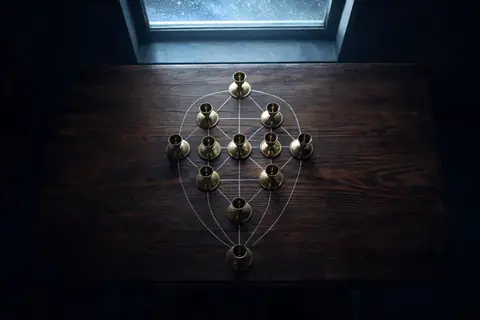
None of this requires abandoning symbolic study. The Star can still be read as a Western esoteric image carrying centuries of accumulated meaning, discussed honestly as exactly that. What changes is the framing: a reader can study the Tree of Life as a tool within Western esotericism, acknowledge plainly that it borrowed from Judaism without that community's involvement, and avoid presenting the result as Jewish wisdom freely available for anyone's spiritual toolkit. Small habits carry this forward: crediting Jewish scholars by name, distinguishing Kabbalah from Cabala in writing, and resisting the urge to smooth over four centuries of appropriation for the sake of a tidier origin story.
Where this series leaves the reader
Across eight parts, this series has tried to hold two things true at once: the tarot's Hebrew-letter symbolism is a real, substantial, centuries-old current worth studying, and it is not Kabbalah, not Jewish tradition, and not something Jewish communities asked for or control. A reader who leaves with both facts intact — curiosity about the symbolism, clarity about its actual origin — has gotten the most honest version of this history available.
Questions
Can someone study both Jewish mysticism and tarot symbolism?
Yes, as long as the two are kept distinct: Kabbalah as a living Jewish tradition, and the tarot's Hebrew-letter symbolism as a separate, later Western esoteric current.
What is the simplest habit for respectful study?
Naming sources precisely, such as crediting the Golden Dawn or Eliphas Levi for a specific attribution rather than calling it ancient Kabbalah in general.
Where should a reader start with genuine Jewish sources?
General encyclopedia entries on Kabbalah are a reasonable first stop, followed by books from scholars working inside or carefully alongside the Jewish tradition.
Does this series argue tarot should drop Hebrew symbolism?
No. It argues for honest framing: the symbolism is a real, substantial esoteric tradition, but it is not Jewish tradition and should not be presented as such.
This article talks about
You might also like
 Kabbalah
 Symbolism
 Kabbalah
© 2026 TAROTS chat (tarots.chat). All rights reserved. No part of this article may be reproduced, distributed or adapted without the owner's written permission.
The Journal
From the Journal
Chosen for this page
 Kabbalah
The Key to the True Quabbalah: Bardon's Letters and the Hebrew Trumps
3 min read
More in Kabbalah Symbolism
Niki de Saint Phalle's Tarot Garden: Twenty-Two Trumps in Tuscany
6 min read
More in Symbolism Kabbalah
 Kabbalah
 Thoth Tarot
 Career
 Symbolism
 Symbolism
 Kabbalah